

Da Chai Hu Tang (Major Bupleurum Decoction)
Actions
What does Da Chai Hu Tang do?
Da Chai Hu Tang vents a Shaoyang-stage pathogen outward while purging heat and accumulation that have collected in the Yangming (bowel) stage at the same time. It treats a combined, two-stage disorder that neither harmonizing alone nor purging alone would fully resolve.
- Harmonizes and vents Shaoyang: the Chai Hu–Huang Qin pair disperses the constrained pathogen and clears the heat it has generated, the same core strategy as Xiao Chai Hu Tang.
- Purges Yangming heat and accumulation: Da Huang and Zhi Shi drain interior excess downward and break up qi stagnation, relieving distension and constipation.
- Harmonizes the Stomach and stops vomiting: Ban Xia and Sheng Jiang direct rebellious qi downward.
- Softens the Liver and protects the blood: Bai Shao relieves abdominal spasm/pain and tempers the purgatives, with Da Zao supporting the Stomach through the purge.
Source: cross-referenced against multiple online sources; Bensky & Barolet, Formulas & Strategies (chief/deputy/assistant analysis, attributed — not from Sacred Lotus composition data, which carries no role field).
Indications
What is Da Chai Hu Tang used for?
Da Chai Hu Tang treats a combined Shaoyang and Yangming pattern — unresolved Shaoyang signs together with heat and stool/food accumulation that has now formed in the bowel, marked by a wiry, rapid, forceful pulse and a yellow tongue coating.
- Persistent fever or alternating chills and fever that has not resolved
- Fullness, distension, or pain spanning the chest, hypochondriac (rib-side) region, and epigastrium/upper abdomen
- Constipation or difficult bowel movements, marking Yangming excess/accumulation
- Vomiting that does not resolve, with a bitter taste and vexation
- Traditionally extended, with modification, to biliary and hepatic complaints (e.g. gallstone or hepatobiliary pain) judged to fit this combined pattern — reference to traditional use, not a treatment claim
Source: Sacred Lotus sources & references (pattern/tongue/pulse) + classical Shang Han Lun presentation, cross-referenced against multiple online sources and Bensky & Barolet, Formulas & Strategies. Traditional-use framing; not medical advice.
Ingredients
8 substances in Da Chai Hu Tang — each links to its full herb monograph.
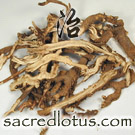 Chai Hu24 gCool, Spicy Herbs that Release the Exterior
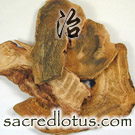 Da Huang6 gPurgatives
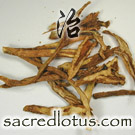 Huang Qin9 gClear Heat and Dry Dampness
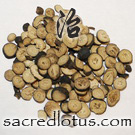 Zhi Shi6-9 gRegulate the Qi
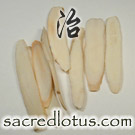 Bai Shao9 gTonify Blood
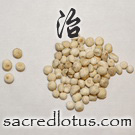 Ban Xia24 gWarm Herbs that Transform Phlegm-Cold
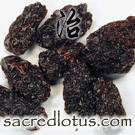 Da Zao12 piecesTonify Qi
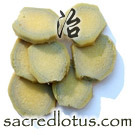 Sheng Jiang15 gWarm, Spicy Herbs that Release the Exterior
Preparation & dosage
How is Da Chai Hu Tang prepared?
Classically it is a water decoction of the eight herbs, taken warm in divided doses. Formulary sources note a processing consideration specific to Da Huang shared across purgative formulas generally.
- Da Huang timing: when a stronger purgative effect is intended, Da Huang is added later in the decoction (after the other herbs have already cooked), since prolonged boiling weakens its laxative action — a standard processing consideration for Da Huang wherever a purgative effect is wanted, including here.
- Ban Xia is used in its processed (Fa Ban Xia) form, standard pharmacopeia practice, since the raw rhizome is irritating to mucosa.
- Sheng Jiang is fresh/uncooked, sliced, per its composition-record annotation.
- Da Zao (whole jujube fruits) is added to support Stomach qi through the purgation.
- Modern practice: a standard water decoction (herbs simmered after an initial boil, then strained) or a granule/powder preparation reconstituted per label.
Source: Bensky & Barolet, Formulas & Strategies (Da Huang processing convention; Ban Xia/Sheng Jiang processing notes), cross-referenced against multiple online sources. Reference only; not administration guidance.
Safety — read before use
What are the cautions for Da Chai Hu Tang?
Da Chai Hu Tang is a purgative formula for genuine Shaoyang-Yangming excess and is inappropriate for deficiency, cold, or diarrhea patterns. Because it combines venting with purging, using it without a true excess/accumulation picture can unnecessarily deplete Stomach-Spleen qi.
- Avoid in Spleen-Stomach deficiency-cold, loose stools, or diarrhea — the purgative direction (Da Huang, Zhi Shi) is contraindicated where there is no genuine excess/accumulation to purge.
- Pregnancy: contains Da Huang, a strong purgative, and Bai Shao/Chuan-invigorating context common to purgative formulas — use only under professional guidance.
- Not for prolonged, unsupervised use once the accumulation has resolved; continuing a purgative formula beyond the acute pattern can injure Stomach qi.
- Ban Xia (Pinellia) is a restricted-processing herb by pharmacopeia convention — the unprocessed rhizome is toxic/irritating and is not used raw; this formula specifies the processed form, noted here as a neutral identity/safety reference, not administration guidance.
Source: Bensky & Barolet, Formulas & Strategies (contraindication pattern for purgative Shaoyang-Yangming formulas); Chinese Pharmacopoeia processing convention for Pinellia (Ban Xia). Traditional-use framing; not medical advice.
Originally Appeared In:
- On Cold Damage (Shang Han Lun)
Notes:
How does Da Chai Hu Tang differ from Xiao Chai Hu Tang and Da Cheng Qi Tang?
Da Chai Hu Tang sits between a pure harmonizing formula and a pure purgative formula, sharing herbs with both.
- vs Xiao Chai Hu Tang: the direct parent formula — Da Chai Hu Tang keeps the Chai Hu–Huang Qin–Ban Xia–Sheng Jiang harmonizing base but drops the tonifying Ren Shen and Zhi Gan Cao and adds Da Huang, Zhi Shi, and Bai Shao, converting a harmonizing-with-tonification strategy into a harmonizing-with-purgation one for a pattern that has progressed to combined Shaoyang–Yangming excess.
- vs Da Cheng Qi Tang: Da Cheng Qi Tang (Da Huang, Mang Xiao, Zhi Shi, Hou Po) is a pure Yangming purgative for bowel excess alone, with no Shaoyang-venting herbs and no Stomach-harmonizing pair — use it when the disorder is purely Yangming; use Da Chai Hu Tang when Shaoyang signs (chest/hypochondriac fullness, nausea, bitter taste) remain alongside the bowel excess.
Classical source: Da Chai Hu Tang originates in Zhang Zhongjing’s Shang Han Lun (Treatise on Cold Damage, Eastern Han dynasty, compiled c. 200–220 CE), given for a Shaoyang disorder that has combined with Yangming excess.
Source: classical attribution per Shang Han Lun, cross-referenced against multiple online sources; Bensky & Barolet, Formulas & Strategies (comparative formula analysis, own words).
Clinical Studies & Research:
Is there modern research on Da Chai Hu Tang?
Yes — a randomized controlled trial on lipid metabolism plus preclinical studies on hepatobiliary protection and liver-cancer cell activity, none of which establishes it as a treatment for any diagnosed disease. Much of the clinical and mechanistic work centers on the formula’s traditional Shaoyang-Yangming, hepatobiliary-clearing action.
- Lipid profiles (clinical, RCT): a 12-week randomized, active-controlled trial found Da-Chai-Hu-Tang reduced triglyceride levels comparably to omega-3 supplementation in patients already on statin therapy (PMID 35330160).
- Intrahepatic cholestasis (preclinical): an animal study found Da-Chai-Hu-Tang protected against acute intrahepatic cholestasis by activating PPARα and reducing liver inflammation and bile accumulation (PMID 35370715).
- Hepatocellular carcinoma cells (preclinical): in vitro work on HepG2 cells found the formula inhibited proliferation and metastasis-related activity via the PI3K/AKT/STAT3 pathway, inducing cell-cycle arrest and apoptosis (PMID 38705430).
Sources: PMID 35330160; PMID 35370715; PMID 38705430. Research context on the formula’s traditional hepatobiliary/metabolic action, not a therapeutic claim.
Sources & References
Compiled and edited by Thomas Dehli, Founder & Editor, Sacred Lotus Updated
The information here is referenced from numerous sources — teachers, practitioners, class notes from Five Branches University, the books below, and the published research literature, with citations given as resolvable PubMed identifiers. Where sources disagree, I have flagged the discrepancies directly. If facts couldn't be verified, I have left them out. How we source our content.
Reference information for students and practitioners — not medical advice. Consult a qualified practitioner. Terms of use.
Chinese Formulas Books & References
 https://amzn.to/4fYI3f8
 https://amzn.to/4j55NRA
 https://amzn.to/4gMROyv
 https://amzn.to/4h7msSK