

Er Miao San (Two Marvel Decoction)
Er Miao San
Two Marvel Decoction
- Category
- Formulas that Expel Dampness
- Subcategory
- Formulas that Clear Damp-Heat
- Ingredients
- 2 herbs
Actions
What does Er Miao San do?
Er Miao San (Two Marvels Powder) clears damp-heat from the lower burner. It is a minimalist, two-herb base formula for damp-heat that pours downward into the lower jiao — combining a bitter, cold herb that drains damp-heat with an acrid, warm, aromatic herb that dries dampness and protects the Spleen from the cold.
How the two ingredients work together:
- Huang Bai (Phellodendron bark), 9–12 g: bitter and cold; drains damp-heat, with a particular affinity for the lower burner.
- Cang Zhu (Atractylodes rhizome), 6–9 g: acrid, bitter, aromatic, and warming; strongly dries dampness and strengthens the Spleen (the source of dampness), while its warmth offsets Huang Bai’s cold.
Together they clear heat and dry dampness without either herb’s temperature dominating — the pattern that makes this pair the foundation for the larger San Miao and Si Miao formulas (see Notes).
Source: Bensky & Barolet, Chinese Herbal Medicine: Formulas & Strategies (2nd ed.), Clear Damp-Heat; composition confirmed against the Sacred Lotus formula record. Traditional-use framing; not medical advice.
Indications
What is Er Miao San used for?
Er Miao San is used for damp-heat pouring into the lower burner. The classic pictures are weak, heavy, or atrophic legs and feet; red, hot, swollen, painful knees or feet; and damp-heat skin and genital complaints — foul yellow vaginal discharge, genital or scrotal itching, and damp rashes or sores in the lower body.
Typical presentation:
- Lower limbs: weakness, heaviness, or atrophy of the legs/feet (atrophy disorder); red, swollen, hot, painful knees or feet; damp leg-qi.
- Genital/urinary & skin: thick, foul, yellow vaginal discharge; genital or perineal itching; damp eczema/sores of the lower body; turbid, yellow urine.
Tongue: yellow, greasy coat. Pulse: soggy (or slippery) and rapid.
Source: Bensky & Barolet, Formulas & Strategies (2nd ed.); tongue per the Sacred Lotus formula record. Traditional-use framing; not medical advice.
Western Uses:
What is Er Miao San used for in modern practice?
In modern TCM practice, practitioners reference Er Miao San (and its San Miao / Si Miao expansions) when a presentation fits its lower-burner damp-heat pattern. Reported reference conditions include gout and gouty arthritis, lower-limb eczema and dermatitis, and damp-heat vaginitis or leukorrhea — the gout/hyperuricemia territory that dominates the modern research (below).
These are pattern-based reference framings, not diagnoses or treatment claims: the formula is chosen for the TCM pattern of damp-heat in the lower burner, and a Western label only appears when that pattern matches. A qualified practitioner confirms the diagnosis.
Source: Bensky & Barolet, Formulas & Strategies (2nd ed.); reported uses consistent with the gout/hyperuricemia focus of the modern literature (PubMed 36123941; 15234772). Reference framing only; not a medical claim.
Ingredients
2 substances in Er Miao San — each links to its full herb monograph.
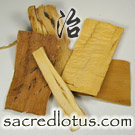 Huang Bai9-12 gClear Heat and Dry Dampness
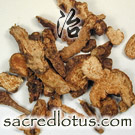 Cang Zhu6-9 gAromatic Herbs that Transform and Dissolve Dampness
Preparation & dosage
How is Er Miao San prepared?
Er Miao San ("Two Marvel Powder") is classically a powder of just two herbs — Huang Bai and Cang Zhu in equal parts — ground finely and taken in small doses, though it is also commonly prepared as a water decoction (tang) today.
Its simplicity makes it a flexible base: practitioners frequently add herbs to it (the well-known San Miao San and Si Miao San extend it with Niu Xi and Yi Yi Ren) to target damp-heat lower in the body. Available as granules.
Source: Sacred Lotus sources & references (composition and preparation note) + Bensky & Barolet, Formulas & Strategies.
Traditionally ground to a powder ("San") and taken with water, or given as a decoction (the Sacred Lotus record). Typical reference amounts: Huang Bai 9-12 g and Cang Zhu 6-9 g. Reference only, not a prescription.
Safety — read before use
What are the cautions for Er Miao San?
Er Miao San is for damp-heat excess, not for cold-damp or deficiency. Because Huang Bai is bitter and cold, it is inappropriate when leg weakness or discharge arises from Spleen/Kidney deficiency or cold-damp without heat, and prolonged use can injure Spleen and Stomach yang.
- Not for cold-damp or deficiency patterns: confirm genuine damp-heat (a yellow, greasy tongue coat) before use.
- Spleen/Stomach deficiency: use cautiously; bitter cold can weaken digestion.
- Pregnancy: use only under professional guidance.
Source: Bensky & Barolet, Formulas & Strategies (2nd ed.), cautions. Not a substitute for professional advice.
Originally Appeared In:
- Teachings of Dan Xi (Dan Xi Xin Fa)
Notes:
How does Er Miao San relate to San Miao San and Si Miao San, and how is it modified?
Er Miao San (“Two Marvels”) is the two-herb base that the larger “Marvels” formulas build on by adding herbs that direct the action downward and drain dampness through the urine.
- San Miao San / Wan (“Three Marvels,” + Niu Xi): Niu Xi guides the action down to the lower limbs and invigorates the blood — favored when there is more leg weakness or joint involvement.
- Si Miao San / Wan (“Four Marvels,” + Niu Xi + Yi Yi Ren): Yi Yi Ren leaches out dampness and resolves it from the sinews — the fullest form, used for damp-heat atrophy/weakness of the lower limbs.
Common modifications:
- For damp-heat skin lesions, add herbs such as Ku Shen or Di Fu Zi.
- For foul, yellow vaginal discharge, add discharge-stopping, damp-heat-clearing herbs.
Naming note: the same two-herb formula appears as both “San” (powder) and “Wan” (pill) in the literature (e.g. “Ermiao wan”); these are preparation-form variants, not different compositions.
Source: Bensky & Barolet, Formulas & Strategies (2nd ed.), Clear Damp-Heat and its associated formulas. Reference only.
Clinical Studies & Research:
Is there modern research on Er Miao San?
Research is largely preclinical and focused on gout and hyperuricemia. A mouse study found that Ermiao wan (the pill form of the same two-herb formula) lowered serum uric acid and inhibited liver xanthine oxidase and xanthine dehydrogenase; network-pharmacology and molecular-docking work maps its active compounds (e.g. quercetin, wogonin) onto inflammatory and uric-acid pathways (NF-κB, IL-17, TNF). Robust human trials are limited.
Source: PubMed 15234772 (J Ethnopharmacol, 2004, Ermiao wan / uric acid & xanthine oxidase in mice); PubMed 36123941 (Medicine (Baltimore), 2022, network pharmacology & molecular docking for hyperuricemia/gout). Research context, not a therapeutic claim.
Sources & References
Compiled and edited by Thomas Dehli, Founder & Editor, Sacred Lotus Updated
The information here is referenced from numerous sources — teachers, practitioners, class notes from Five Branches University, the books below, and the published research literature, with citations given as resolvable PubMed identifiers. Where sources disagree, I have flagged the discrepancies directly. If facts couldn't be verified, I have left them out. How we source our content.
Reference information for students and practitioners — not medical advice. Consult a qualified practitioner. Terms of use.
Chinese Formulas Books & References
 https://amzn.to/4fYI3f8
 https://amzn.to/4j55NRA
 https://amzn.to/4gMROyv
 https://amzn.to/4h7msSK