

Ren Shen Bai Du San (Ginseng Powder to Overcome Pathogenic Influences)
Ren Shen Bai Du San
Ginseng Powder to Overcome Pathogenic Influences
- Category
- Formulas that Release the Exterior
- Ingredients
- 12 herbs
Actions
What does Ren Shen Bai Du San do?
Ren Shen Bai Du San releases external wind-cold-damp while simultaneously tonifying the underlying qi deficiency that let the pathogen take hold — a “support the upright while dispelling the pathogen” (fu zheng jie biao) strategy, rather than exterior release alone. Ten dispersing, regulating, and transforming herbs are built around a single tonifying herb, Ren Shen, which gives the formula its name and its defining logic.
The twelve ingredients divide by role:
- Chiefs: Qiang Huo and Du Huo release wind-cold-damp from the exterior and unblock the channels to relieve body aches — Qiang Huo directed toward the upper body and head, Du Huo toward the lower back and limbs, together covering aching and heaviness from head to foot.
- Deputies: Chuan Xiong invigorates the blood and helps dispel wind to relieve headache; Chai Hu releases the exterior and lifts clear yang; Qian Hu and Jie Geng work as a pair to regulate the Lung’s qi mechanism — Jie Geng opens and raises Lung qi while Qian Hu directs it back downward and expels phlegm, together easing cough, chest oppression, and copious sputum.
- Assistants: Zhi Ke regulates qi and relieves fullness in the chest and epigastrium; Fu Ling drains dampness, strengthens the Spleen, and helps prevent phlegm from forming; Ren Shen tonifies qi to support the body’s own resistance (zheng qi), so the acrid, dispersing herbs release the pathogen without further depleting an already-deficient patient.
- Envoy: Gan Cao harmonizes the other herbs and assists Ren Shen’s tonifying action; Sheng Jiang and Bo He are traditionally added at the time of cooking to assist the dispersal of wind and cold.
Source: Sacred Lotus sources & references (composition) cross-referenced against multiple online sources; Bensky & Barolet, Formulas & Strategies (chief/deputy/assistant/envoy analysis). Traditional-use framing; not medical advice.
Indications
What is Ren Shen Bai Du San used for?
Ren Shen Bai Du San treats an external attack of wind-cold-damp occurring in someone whose qi is already weak — classically the elderly, the chronically ill, postpartum women, or young children — where ordinary exterior-releasing formulas risk further exhausting a person too depleted to expel the pathogen on their own.
Its classic clinical presentation:
- Exterior signs: pronounced chills, often more severe than any fever, with little or no sweating.
- Head and body: a heavy, aching head and body, and a stiff, sore neck and back.
- Chest and Lung: stuffy, congested nose, cough with copious white sputum, and a sensation of fullness or oppression in the chest.
- Underlying deficiency: a weak voice, fatigue, or general frailty pointing to qi deficiency beneath the exterior pattern.
- Classical extension: historically also used at the onset of dysenteric disorders accompanied by exterior signs (fever, chills, body aches) — a technique later named “sailing against the current” (ni liu wan zhou) by physician Yu Chang, which releases the exterior to help resolve a concurrent interior disorder.
Tongue and pulse: normal-colored tongue with a white, greasy coat; a floating and soggy pulse, reflecting an exterior pattern layered over dampness and deficiency.
Source: Sacred Lotus sources & references (pattern/tongue/pulse) cross-referenced against multiple online sources; Bensky & Barolet, Formulas & Strategies; Chen & Chen, Chinese Medical Herbology and Pharmacology. Traditional-use framing; not medical advice.
Western Uses:
What conditions is Ren Shen Bai Du San used for in modern practice?
Ren Shen Bai Du San releases an exterior wind-cold-damp invasion in someone with underlying qi deficiency (chills, fever, body aches, cough in a depleted or elderly person), so it is referenced for early infectious and exterior presentations: the common cold, influenza, malaria, early-stage dysentery, early-stage measles, and suppurative (pus-forming) infections.
It is chosen for the exterior-invasion-with-qi-deficiency pattern, not for a diagnosis. Malaria is a life-threatening emergency — any traveller's fever must be tested for it — and measles is a serious, vaccine-preventable illness; dysentery and spreading infection need medical treatment. Traditional-use correlates only, not a treatment claim.
Source: Sacred Lotus sources & references (pattern) + Bensky & Barolet, Formulas & Strategies; biomedical correlates as reference only. Not medical advice.
Ingredients
12 substances in Ren Shen Bai Du San — each links to its full herb monograph.
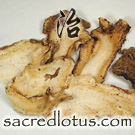 Du Huo6-9 gDispel Wind-Dampness
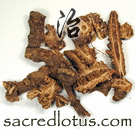 Qiang Huo6-9 gWarm, Spicy Herbs that Release the Exterior
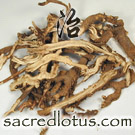 Chai Hu6-9 gCool, Spicy Herbs that Release the Exterior
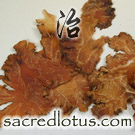 Chuan Xiong6-9 gInvigorate Blood and Remove Stagnation
 Bo He3-6 gCool, Spicy Herbs that Release the Exterior
 Fu Ling6-9 gRegulate Water and Drain Dampness
 Jie Geng6-9 gWarm Herbs that Transform Phlegm-Cold
 Qian Hu6-9 gCool and Transform Phlegm-Heat
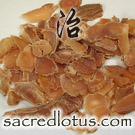 Ren Shen6-9 gTonify Qi
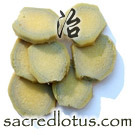 Sheng Jiang3-6 gWarm, Spicy Herbs that Release the Exterior
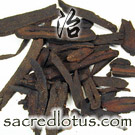 Zhi Ke6-9 gRegulate the Qi
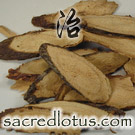 Gan Cao3 gTonify Qi
Preparation & dosage
How is Ren Shen Bai Du San prepared?
Ren Shen Bai Du San is prepared as a water decoction, traditionally taken warm to support a light, sustained sweat that carries the wind-cold-damp out through the surface. In its classical form it was ground into a coarse powder and simmered briefly with a small amount of ginger and mint rather than fully decocted like a standard tang.
Sheng Jiang and Bo He are conventionally added toward the end of cooking: both are aromatic and volatile, and prolonged boiling drives off the very qi-dispersing action they are included for. Modern practice most often decocts the full set of herbs together as a standard tang, adjusted to the patient’s constitution and the severity of the exterior versus deficiency components.
Source: Bensky & Barolet, Formulas & Strategies (classical form and decoction method); cross-referenced against multiple online sources.
Safety — read before use
What are the cautions for Ren Shen Bai Du San?
Ren Shen Bai Du San is built for a wind-cold-damp exterior pattern occurring specifically alongside qi deficiency, so it is not appropriate for a straightforward wind-heat cold or for a robust constitution with no underlying weakness. Used outside that combined pattern, its warming, drying, and tonifying herbs can aggravate rather than help.
- Not for wind-heat or interior heat: avoid where fever predominates over chills, with marked thirst, sore throat, or a red tongue — signs of heat that the formula’s warm, acrid herbs would worsen.
- Not for profuse sweating: unsuitable when spontaneous or profuse sweating is already present, since further dispersal could injure fluids.
- Yin deficiency: use cautiously, or not at all, in patients with underlying yin deficiency, as the formula’s warm, drying herbs can further consume yin with prolonged use.
- Pregnancy: contains Chuan Xiong, a blood-invigorating herb — use only under professional guidance.
- Short-course, pattern-specific use: intended for the acute exterior stage in a deficient constitution; it is not a general-purpose tonic and is not meant for long-term use once the exterior pattern has resolved.
Source: Bensky & Barolet, Formulas & Strategies; Chen & Chen, Chinese Medical Herbology and Pharmacology (cautions for combined tonifying/exterior-releasing formulas); cross-referenced against multiple online sources. Traditional-use framing; not medical advice.
Originally Appeared In:
- Craft of Medicinal Treatment for Childhood Disease Patterns (Xiao Er Yao Zheng Zhi Jue)
Notes:
How is Ren Shen Bai Du San different from related formulas, and what is its classical background?
Ren Shen Bai Du San is distinguished from its closest relatives by the presence of Ren Shen and the combined support-while-dispelling strategy it enables.
- vs Jing Fang Bai Du San: this related formula removes Ren Shen and adds Jing Jie and Fang Feng, dropping the tonifying element in favor of stronger, purely dispersing action — it suits a sturdier constitution and is more often used for wind-cold-damp exterior patterns with early-stage sores or toxic swellings, whereas Ren Shen Bai Du San is reserved for patients whose qi is already deficient.
- vs Xiao Chai Hu Tang: both include Ren Shen and Chai Hu, but Xiao Chai Hu Tang harmonizes a Shaoyang half-exterior/half-interior pattern (alternating chills and fever, bitter taste, chest-and-rib-side fullness) and carries no Qiang Huo, Du Huo, or other wind-damp-dispersing herbs; Ren Shen Bai Du San targets a true surface wind-cold-damp invasion with concurrent body aching and heaviness.
Classical source: the formula is traditionally attributed to Qian Yi’s Xiao Er Yao Zheng Zhi Jue (Craft of Medicinal Treatment for Childhood Disease Patterns), Song dynasty, and later became a mainstay for exterior wind-cold-damp in weakened patients generally, not only children. Its best-known modification is Yu Chang’s “sailing against the current” (ni liu wan zhou) method, described in his Yi Men Fa Lu, which uses the formula’s exterior-releasing action at the onset of dysenteric disorders that present with concurrent chills, fever, and body aches.
Source: Bensky & Barolet, Formulas & Strategies (formula comparisons and classical source); cross-referenced against multiple online sources. Traditional-use framing; not medical advice.
Clinical Studies & Research:
Is there modern research on Ren Shen Bai Du San?
Limited, but one controlled animal study on a closely related Korean formulation (Insampaedok-san, described by its authors as equivalent to Ren Shen Bai Du San in Chinese nomenclature) found it safe at high oral doses and protective in an allergic-asthma model. No human clinical trials of the classical formula itself were found.
- Acute toxicity: a single oral dose of 5,000 mg/kg in rats produced no adverse effects, indicating a wide margin of safety for the extract at that dose.
- Ovalbumin-induced asthma model (mice): pretreatment reduced airway inflammatory cell recruitment and mucus hypersecretion, lowered the inflammatory cytokines IL-4, IL-5, and eotaxin, decreased OVA-specific IgE, and increased lung superoxide dismutase activity — findings the authors linked to combined anti-inflammatory and antioxidant mechanisms (PMID 25264130, BMC Complementary and Alternative Medicine, 2014).
Sources: PubMed 25264130. Research context on a related formulation, not a therapeutic claim; direct clinical trial evidence for Ren Shen Bai Du San itself is currently lacking.
Sources & References
Compiled and edited by Thomas Dehli, Founder & Editor, Sacred Lotus Updated
The information here is referenced from numerous sources — teachers, practitioners, class notes from Five Branches University, the books below, and the published research literature, with citations given as resolvable PubMed identifiers. Where sources disagree, I have flagged the discrepancies directly. If facts couldn't be verified, I have left them out. How we source our content.
Reference information for students and practitioners — not medical advice. Consult a qualified practitioner. Terms of use.
Chinese Formulas Books & References
 https://amzn.to/4fYI3f8
 https://amzn.to/4j55NRA
 https://amzn.to/4gMROyv
 https://amzn.to/4h7msSK