

Bu Fei e Jiao Tang (Tonify the Lungs Decoction with Ass Hide Gelatin)
Bu Fei e Jiao Tang
Tonify the Lungs Decoction with Ass Hide Gelatin
- Category
- Formulas that Treat Dryness
- Subcategory
- Formulas that Enrich the Yin and Moisten Dryness
- Ingredients
- 6 herbs
Actions
What does Bu Fei E Jiao Tang do?
Bu Fei E Jiao Tang (Tonify the Lungs Decoction with Ass Hide Gelatin) nourishes Lung yin, stops bleeding, and clears the deficiency heat that arises once Lung yin runs low. It targets the chronic dry cough and blood-streaked sputum that follow from a Lung deprived of its moistening fluids, rather than an acute infection.
The six ingredients divide by role:
- Chief: E Jiao (donkey-hide gelatin) — richly nourishes Lung yin and blood and stops bleeding from damaged Lung vessels; used at the heaviest dose in the formula.
- Deputies: Ma Dou Ling clears Lung heat, transforms phlegm, and calms coughing; Niu Bang Zi disperses Lung qi, clears heat, and benefits the throat, keeping E Jiao’s rich, cloying nature from stagnating.
- Assistants: Xing Ren descends Lung qi and stops coughing while complementing E Jiao’s moistening action; Geng Mi (rice) supports the Spleen so it can generate the Lung — “cultivating earth to generate metal” — and helps buffer E Jiao’s cloying quality.
- Envoy: Zhi Gan Cao (honey-fried licorice) harmonizes the formula and protects the Spleen and Stomach from E Jiao’s richness.
Most published sources, including Bensky & Barolet, list this assistant position as Nuo Mi (glutinous rice); this site’s own record records Geng Mi (ordinary rice). Both fill the same “tonify the Spleen to support the Lung” role, so the formula’s classical logic is unaffected — the database composition is used here as authoritative.
Source: this site’s own composition record + Bensky & Barolet, Formulas & Strategies (chief/deputy/assistant/envoy analysis), cross-referenced against multiple online sources. Traditional-use framing; not medical advice.
Indications
What is Bu Fei E Jiao Tang used for?
Bu Fei E Jiao Tang treats Lung yin deficiency with deficiency heat — the Lungs lack the moist, cooling fluids needed to keep the airway lubricated, and the resulting empty heat drives a chronic, unproductive cough.
Its classic clinical presentation:
- Cough: chronic dry cough, often worse at night, with scanty, sticky phlegm that is difficult to expectorate.
- Heat/bleeding signs: blood-streaked sputum where deficiency heat has damaged the Lung’s vessels, dry or sore throat, and a hoarse voice.
- Associated signs: possible wheezing or shortness of breath as the Lung’s descending function is impaired.
Tongue and pulse: the tongue is red with little or no coat; the pulse is floating, thin, and rapid.
Originally formulated by the Song-dynasty pediatrician Qian Yi for children’s “delicate” constitutions, it is used in adults with the same pattern today, typically at higher dosage.
Source: this site’s own pattern/tongue/pulse record + Bensky & Barolet, Formulas & Strategies. Traditional-use framing; not medical advice.
Western Uses:
What is Bu Fei E Jiao Tang used for in modern practice?
In modern practice Bu Fei E Jiao Tang is referenced for chronic, “dry-type” respiratory conditions — states Western medicine would frame as chronic dry cough, chronic bronchitis, bronchiectasis, or a dry cough with blood-tinged sputum — where the traditional heat-in-deficiency pattern is present.
This biomedical correlate is offered as a reference to the formula’s traditional use, not as a claim that it treats any diagnosed disease. A significant modern-practice caveat: Ma Dou Ling, one of its deputy herbs, contains aristolochic acid, and products containing Aristolochia species have been restricted since a 2001 US FDA import alert and by regulators in many other countries. As a result, contemporary practitioners generally do not compound this formula as classically written — they omit or substitute Ma Dou Ling (see notes). Any use for a diagnosed condition belongs with a qualified practitioner and appropriate medical care.
Source: traditional-use correlates summarized from Bensky & Barolet, Formulas & Strategies; Ma Dou Ling regulatory status from the US FDA aristolochic-acid import alert (2001). Reference only, not a treatment claim.
Ingredients
6 substances in Bu Fei e Jiao Tang — each links to its full herb monograph.
 E Jiao45 gTonify Blood
 Ma Dou Ling15 gRelieve Coughing and Wheezing
 Niu Bang Zi7.5 gCool, Spicy Herbs that Release the ExteriorNo specimen photographGeng Mi30 gTonify Qi
 Xing Ren6 gRelieve Coughing and Wheezing
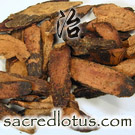 Zhi Gan Cao7.5 gTonify Qi
Preparation & dosage
How is Bu Fei E Jiao Tang prepared?
Bu Fei E Jiao Tang is taken as a decoction, with E Jiao added at the end rather than boiled with the other herbs. The other five herbs are decocted together and strained first; the E Jiao (a gelatin) is then dissolved into the hot strained liquid, since boiling it directly with the other ingredients causes it to adhere to them and lose potency.
Source: this site’s own preparation note, consistent with standard Chinese herbal practice for gelatin (jiao) substances in decoctions.
Decoction; E Jiao dissolved separately into the strained hot liquid. Reference relative amounts (per this site’s own record): E Jiao 45 g; Geng Mi (rice) 30 g; Ma Dou Ling 15 g; Niu Bang Zi 7.5 g; Zhi Gan Cao (honey-fried) 7.5 g; Xing Ren 6 g. Originally dosed for children and traditionally reduced accordingly; modern practice commonly omits or substitutes Ma Dou Ling due to its aristolochic acid content. Reference only, not a prescription.
Safety — read before use
What are the cautions for Bu Fei E Jiao Tang?
The formula’s central modern caution is Ma Dou Ling itself. Ma Dou Ling (Aristolochia fructus) contains aristolochic acid, a documented nephrotoxin and IARC Group 1 human carcinogen; the US FDA issued an import alert restricting Aristolochia-containing botanicals in 2001, and many other countries restrict or ban it outright. In current practice this herb is generally omitted or substituted (e.g., with Sang Bai Pi) rather than used as classically formulated.
- Not for cold-type cough: avoid where cough arises from Lung qi or yang deficiency, or from an acute Wind-Cold exterior invasion, without underlying heat signs.
- Spleen-Stomach deficiency with damp-phlegm: E Jiao’s rich, cloying nature can burden a weak Spleen and worsen dampness or reduce appetite — use cautiously or modify.
- Active or profuse bleeding: the formula’s bleeding-related use targets deficiency-heat damage to Lung vessels specifically, not other causes of hemorrhage.
- Pregnancy, breastfeeding, and children: given Ma Dou Ling’s toxicity profile, any use of this formula in these populations should be under professional guidance and with the herb omitted.
Source: Bensky & Barolet, Formulas & Strategies (cautions for Lung yin-tonifying formulas) + US FDA aristolochic-acid import alert (2001); see research for a formula-specific nephrotoxicity study. Traditional-use framing; not medical advice.
Originally Appeared In:
- Craft of Medicinal Treatment for Childhood Disease Patterns (Xiao Er Yao Zheng Zhi Jue)
Notes:
How does Bu Fei E Jiao Tang compare to other Lung-yin formulas, and how is it modified?
Bu Fei E Jiao Tang is chosen over related Lung-yin formulas specifically when blood-streaked sputum and clear heat signs predominate in a chronic dry cough.
- vs Bai He Gu Jin Tang: a larger formula that nourishes both Lung and Kidney yin together — better suited to deeper or longer-standing yin depletion than Bu Fei E Jiao Tang addresses alone.
- vs Mai Men Dong Tang: that formula centers on Stomach yin failing to nourish the Lung (rebellious qi, Ban Xia to descend it); Bu Fei E Jiao Tang is preferred when Lung-heat and bleeding signs are more prominent than digestive rebellion.
- vs Bu Fei Tang: a contrasting approach — Bu Fei Tang tonifies Lung qi (Ren Shen, Huang Qi) for a weak cough with spontaneous sweating and a pale tongue, not the yin-deficiency-with-heat pattern here.
Common modifications: add Bai Ji and Xian He Cao to strengthen the hemostatic effect when blood-streaked sputum is pronounced; add Tian Men Dong and Bei Sha Shen for more severe dryness with scanty phlegm; substitute Sang Bai Pi for Ma Dou Ling to retain Lung heat-clearing action while avoiding aristolochic acid exposure.
Source: Bensky & Barolet, Formulas & Strategies (formula comparisons and modifications), cross-referenced against multiple online sources.
Clinical Studies & Research:
Is there modern research on Bu Fei E Jiao Tang?
Yes, but modern research on this formula centers on the safety of Ma Dou Ling rather than on the formula’s tonifying efficacy. A mouse metabolomics and histopathology study tested the compound formula (referred to as Bu-Fei-A-Jiao-Tang, BFAJT) alongside pure aristolochic acid and Ma Dou Ling alone, to see whether the classical chief-deputy-assistant-envoy design could reduce Ma Dou Ling’s kidney toxicity. It found all three — the AA standard, Ma Dou Ling alone, and the full BFAJT formula — were nephrotoxic in this model, with damage concentrated in the proximal tubules; combining Ma Dou Ling with the formula’s other herbs did not measurably offset the toxicity.
- Formula-specific nephrotoxicity (mouse, preclinical): metabolomic and histopathological analysis found Bu-Fei-A-Jiao-Tang nephrotoxic despite its classical formula design (PMID 23606874; PMC 3626396).
- Broader context (review): aristolochic acid nephropathy is a well-documented, dose-related risk associated with Aristolochia-containing herbs generally, including a distinctive mutational signature and elevated urinary-tract cancer risk (PMID 23238808).
Sources: PubMed 23606874 / PMC 3626396; PubMed 23238808. Research context on ingredient safety, not a claim of therapeutic effect; no clinical-efficacy trials of the compound formula were found.
Sources & References
Compiled and edited by Thomas Dehli, Founder & Editor, Sacred Lotus Updated
The information here is referenced from numerous sources — teachers, practitioners, class notes from Five Branches University, the books below, and the published research literature, with citations given as resolvable PubMed identifiers. Where sources disagree, I have flagged the discrepancies directly. If facts couldn't be verified, I have left them out. How we source our content.
Reference information for students and practitioners — not medical advice. Consult a qualified practitioner. Terms of use.
Chinese Formulas Books & References
 https://amzn.to/4fYI3f8
 https://amzn.to/4j55NRA
 https://amzn.to/4gMROyv
 https://amzn.to/4h7msSK