

Ding Chuan Tang (Arrest Wheezing Decoction)
Ding Chuan Tang
Arrest Wheezing Decoction
- Category
- Formulas that Regulate the Qi
- Subcategory
- Formulas that Direct Rebellious Qi Downward
- Ingredients
- 9 herbs
Actions
What does Ding Chuan Tang do?
Ding Chuan Tang disperses constraint at the Lung's exterior while simultaneously clearing phlegm-heat and directing rebellious Lung qi back down. Its central logic is a single herb pair working in opposite directions at once: Ma Huang disperses and opens, Bai Guo astringes and holds — so Lung qi is released without being scattered.
- Disperses wind-cold from the exterior and diffuses Lung qi — Ma Huang opens the exterior and the Lung, relieving wheezing caused by qi that cannot diffuse outward.
- Astringes the Lung and stabilizes qi — Bai Guo restrains Ma Huang's dispersing tendency, preventing excessive sweating/qi leakage and steadying the breath, rather than letting the formula scatter Lung qi unchecked.
- Directs rebellious qi downward and stops cough/wheeze — Su Zi, Xing Ren, and Kuan Dong Hua all descend Lung qi and calm the urge to cough or wheeze.
- Clears Lung heat and transforms phlegm — Sang Bai Pi and Huang Qin clear heat from the Lung, while Ban Xia dries dampness and transforms phlegm, addressing the thick, yellow sputum of the phlegm-heat component.
- Harmonizes — Gan Cao moderates the formula's other actions and protects Stomach qi.
Source: Bensky & Barolet, Formulas & Strategies (2nd ed.); cross-referenced against multiple online sources.
Indications
What is Ding Chuan Tang used for?
Ding Chuan Tang treats wheezing and cough from an unresolved wind-cold exterior combined with phlegm-heat obstructing the Lung — a mixed cold-outside/heat-inside presentation typical of an asthma or bronchitis flare that has begun to generate heat.
- Wheezing with a sensation of qi rushing upward and chest fullness/oppression
- Cough with copious, thick, difficult-to-expectorate sputum, often yellow
- Residual exterior signs — mild chills, fever, or aversion to wind/cold — alongside the phlegm-heat picture
- Breathing that worsens with exertion, lying flat, or cold exposure
- A sense of tightness or fullness in the chest that intensifies as the wheeze worsens
Tongue and pulse: a red tongue with a greasy yellow coat; a rapid, slippery pulse — both reflecting phlegm-heat rather than a purely cold or purely deficient presentation.
Source: Sacred Lotus sources & references on tongue/pulse (already on file); Bensky & Barolet, Formulas & Strategies (2nd ed.); cross-referenced against multiple online sources.
Western Uses:
What conditions is Ding Chuan Tang used for in modern practice?
Ding Chuan Tang "arrests wheezing" — it treats an exterior wind-cold constraint with internal phlegm-heat obstructing the Lung (wheezing, cough with thick sputum) — so it is referenced for wheezing respiratory conditions: asthma (including bronchial asthma), chronic bronchitis, and pulmonary emphysema.
It is chosen for the phlegm-heat-with-exterior-constraint pattern, not for a diagnosis. Asthma is a serious condition requiring medical management, and a severe asthma attack is a life-threatening emergency — acupuncture and herbs are not a substitute for inhalers or emergency care. Emphysema (COPD) likewise needs medical management. Traditional-use correlates only, not a treatment claim.
Source: Sacred Lotus sources & references (pattern) + Bensky & Barolet, Formulas & Strategies; biomedical correlates as reference only. Not medical advice.
Ingredients
9 substances in Ding Chuan Tang — each links to its full herb monograph.
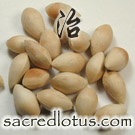 Bai Guo9 g9 piecesAstringe, Stabilize, Bind
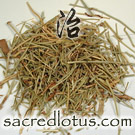 Ma Huang9 gWarm, Spicy Herbs that Release the Exterior
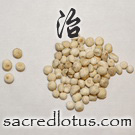 Ban Xia9 gWarm Herbs that Transform Phlegm-Cold
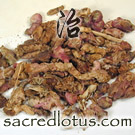 Kuan Dong Hua9 gRelieve Coughing and Wheezing
 Xing Ren4.5 gRelieve Coughing and Wheezing
 Zi Su Zi6 gRelieve Coughing and Wheezing
 Huang Qin4.5 gClear Heat and Dry Dampness
 Sang Bai Pi9 gRelieve Coughing and Wheezing
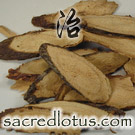 Gan Cao3 gTonify Qi
Preparation & dosage
How is Ding Chuan Tang prepared?
Taken as a decoction of all nine herbs, typically simmered together and strained for oral use. Bai Guo is used shelled and lightly crushed so its action is released into the decoction; cooking the seed also mitigates the mild toxicity of the raw kernel, one reason it is always taken decocted rather than eaten raw. The formula is intended for the acute wheezing episode and is typically adjusted or discontinued as the exterior and phlegm-heat clear, rather than continued long-term unchanged.
Source: Bensky & Barolet, Formulas & Strategies (2nd ed.); cross-referenced against multiple online sources.
Safety — read before use
What are the cautions for Ding Chuan Tang?
Ding Chuan Tang is built for a mixed wind-cold-exterior/phlegm-heat-interior wheeze; it is not suited to chronic, deficiency-type wheezing (weak voice, spontaneous sweating, breathlessness on exertion without phlegm-heat signs), which calls for tonifying formulas instead.
- Ma Huang (Ephedra) content: Ma Huang contains ephedrine-type alkaloids. Ephedrine/ephedra-containing products are restricted or banned as dietary supplements in a number of countries (for example, the U.S. FDA's 2004 ban on ephedrine-alkaloid supplements), and ephedrine is a controlled or monitored substance in many jurisdictions and in competitive sport. This is provided as neutral public-safety reference only, not as administration guidance.
- Cardiovascular/stimulant caution: caution is generally advised in hypertension, cardiovascular disease, hyperthyroidism, and anxiety/insomnia given Ma Huang's stimulating, pressor-type action.
- Bai Guo (ginkgo seed) toxicity: raw or excessive ginkgo seed intake is associated with toxicity, including in children; the seed is always used cooked/decocted in this formula, never eaten raw in quantity.
- Not for prolonged, unmodified use: intended for the acute phlegm-heat wheeze episode; the formula is typically modified or discontinued as the exterior and phlegm-heat resolve.
- Pregnancy and pediatric use: given the Ma Huang content, use in pregnancy or in young children should be guided by a qualified practitioner.
Source: Bensky & Barolet, Formulas & Strategies (2nd ed.); cross-referenced against multiple online sources (Ma Huang/ephedrine regulatory status; ginkgo seed toxicity). Not a substitute for professional advice.
Originally Appeared In:
- Exquisite Formulas for Fostering Longevity (Fu Shou Jing Fang)
Notes:
How does Ding Chuan Tang differ from Ma Xing Shi Gan Tang and Su Zi Jiang Qi Tang?
All three formulas address Lung-qi rebellion with wheezing, but they diverge on whether an exterior pattern is still present and on whether the underlying imbalance is heat, phlegm, or deficiency.
- vs Ma Xing Shi Gan Tang: treats Lung-heat wheeze once the exterior has essentially transformed into interior heat, pairing Ma Huang with cooling Shi Gao (gypsum) rather than with astringent Bai Guo — there is no astringing component because the goal is to vent heat outward, not restrain dispersal.
- vs Su Zi Jiang Qi Tang: built for an “upper excess, lower deficiency” pattern — phlegm-cold obstructing above with underlying Kidney qi failing to grasp qi below — and so combines phlegm-directing herbs with Kidney-supporting ones, rather than Ding Chuan Tang's exterior-release-plus-phlegm-heat-clearing strategy.
Ding Chuan Tang is traditionally dated to the Ming dynasty; contemporary pharmacological literature describes it as having been used for wheezing and respiratory inflammation in China for more than 400 years (PMID 30233137). Well-known modifications include increasing Huang Qin and Sang Bai Pi when phlegm-heat is more pronounced, or removing Ma Huang once the exterior wind-cold component has resolved.
Source: Bensky & Barolet, Formulas & Strategies (2nd ed.); PubMed 30233137 (historical-use note); cross-referenced against multiple online sources.
Clinical Studies & Research:
Is there modern research on Ding Chuan Tang?
Yes — a randomized controlled trial in children and supporting animal/mechanistic studies back its traditional use for asthma-type wheezing.
- Randomized, double-blind clinical trial (children with stable asthma): 52 children aged 8–15 with mild-to-moderate persistent asthma received Ding Chuan Tang or placebo alongside standard care for 12 weeks; airway hyper-responsiveness, symptom scores, and medication use all improved significantly more in the treatment group (PMID 16846448, Pediatr Allergy Immunol 2006).
- Airway inflammation (animal model): in ovalbumin-sensitized asthmatic mice, the formula reduced airway hyperresponsiveness, eosinophil infiltration, mucus production, and the inflammatory cytokines IL-5 and IL-13 (PMID 34595240, Biomed Res Int 2021).
- Anti-inflammatory mechanism (cell model): the formula's essential oil suppressed production of inflammatory mediators (nitric oxide, prostaglandin E2, IL-1β, IL-6, TNF-α) in stimulated macrophages by blocking the IRAK/NF-κB, IRAK/AP-1, and TBK1/IRF3 signaling pathways (PMID 30233137, Drug Des Devel Ther 2018).
Sources: PubMed 16846448; PubMed 34595240; PubMed 30233137. Research context only, not a therapeutic claim; asthma always warrants ongoing medical management.
Sources & References
Compiled and edited by Thomas Dehli, Founder & Editor, Sacred Lotus Updated
The information here is referenced from numerous sources — teachers, practitioners, class notes from Five Branches University, the books below, and the published research literature, with citations given as resolvable PubMed identifiers. Where sources disagree, I have flagged the discrepancies directly. If facts couldn't be verified, I have left them out. How we source our content.
Reference information for students and practitioners — not medical advice. Consult a qualified practitioner. Terms of use.
Chinese Formulas Books & References
 https://amzn.to/4fYI3f8
 https://amzn.to/4j55NRA
 https://amzn.to/4gMROyv
 https://amzn.to/4h7msSK