

Gun Tan Wan (Vaporize Phlegm Pill)
Gun Tan Wan
Vaporize Phlegm Pill
- Category
- Formulas that Open the Orifices
- Subcategory
- Formulas that Scour Phlegm and Open the Orifices
- Ingredients
- 4 herbs
Actions
What does Gun Tan Wan do?
Gun Tan Wan (礞石滚痰丸, “Vaporize Phlegm Pill”) drains fire and forcefully expels stubborn, deep-lodged phlegm by pairing a heavy mineral that physically dislodges phlegm with two bitter, cold herbs that purge the heat driving it, using the bowels as the exit route.
The four ingredients divide by role:
- Chief: Meng Shi (calcined chlorite-schist) — a heavy, sinking mineral that settles and scours out old, stubborn phlegm lodged deep in the body, giving the formula its name and its forceful “rolling away” action.
- Deputies: Da Huang and Huang Qin, both bitter and cold, purge accumulated fire — Da Huang drains it downward through the bowels (providing the exit route for the dislodged phlegm), while Huang Qin clears fire at its source in the upper body.
- Assistant/Envoy: Chen Xiang, aromatic and warm, rapidly directs qi downward, guiding the heavy mineral and cold purgatives through the body and moderating their harshness so they do not stall in the middle burner.
Standard formula references vary slightly on whether Chen Xiang is best classified as assistant or envoy; its downward-guiding, moderating action plausibly serves both roles in this four-herb formula.
Source: this site’s own composition record (authoritative) + cross-checked chief/deputy/assistant/envoy analysis from standard TCM formula references. Traditional-use framing; not medical advice.
Indications
What is Gun Tan Wan used for?
Gun Tan Wan treats stubborn Phlegm-Fire accumulation with marked excess heat — a pattern where thick, deeply lodged phlegm combines with fire severe enough to disturb the Heart and Stomach, going well beyond the milder phlegm-heat cough patterns that gentler formulas are used for.
Its classic clinical presentation:
- Phlegm-heat in the chest/Lung-Stomach: thick, sticky yellow sputum that is difficult to cough up, chest and epigastric fullness, dizziness, tinnitus.
- Bowel heat: constipation with dry, hard stool.
- Phlegm misting the Heart (more severe presentations): palpitations, insomnia, marked agitation or mania-type disturbance, incoherent speech, or seizure-type episodes attributed to phlegm-fire.
Tongue and pulse: a thick, greasy, yellow tongue coating; a slippery, rapid, and forceful pulse — signs of substantial heat bound up with entrenched phlegm.
Source: this site’s own pattern/tongue/pulse record + cross-checked TCM formula references. Traditional-use framing; not medical advice.
Western Uses:
What is Gun Tan Wan used for in modern practice?
Gun Tan Wan is referenced in Chinese medicine literature for marked agitation, disturbed sleep, and copious thick phlegm occurring together with a confirmed excess-heat pattern — contexts practitioners have traditionally linked to presentations such as severe insomnia, anxiety, and phlegm-heavy respiratory complaints.
These are traditional-use correlates only, not a claim that the formula treats any diagnosed disease. It is not a substitute for psychiatric, neurological, or other medical evaluation and care; conditions such as marked mania, psychosis, or seizure disorders require qualified medical diagnosis and treatment. Direct clinical research on the formula itself is limited (see research).
Source: traditional-use correlates summarized from cross-checked TCM formula references; reference only, not a treatment claim.
Ingredients
4 substances in Gun Tan Wan — each links to its full herb monograph.
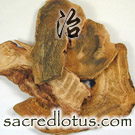 Da Huang240 gPurgatives
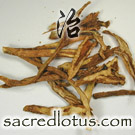 Huang Qin240 gClear Heat and Dry Dampness
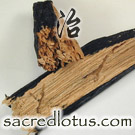 Chen Xiang15 gRegulate the Qi
Preparation & dosage
How is Gun Tan Wan prepared?
Gun Tan Wan ("Vaporize Phlegm Pill") is prepared as water pills: the herbs are ground to an even powder and bound with water into pills, taken in a small 6–9 g dose, once or twice a day with warm water — the pill form deliberately giving this strong phlegm-heat purgative a controlled, gradual action.
Preparation matters here: Meng Shi (chlorite/mica schist) is a mineral that is calcined (dry-roasted) before use to make it effective, and the aromatic Chen Xiang is added for its downward-moving qi. This is a potent formula for a practitioner to direct, not for casual use.
Source: Sacred Lotus sources & references (composition and preparation note) + Bensky & Barolet, Formulas & Strategies.
Classical proportions for pill-making (per this site’s own composition record): Meng Shi (calcined) 30 g; Da Huang 240 g; Huang Qin 240 g; Chen Xiang 15 g — ground to a fine powder and formed into pills. Typical dose: 6-9 g, 1-2 times a day with warm water. As a strong purgative it is traditionally used only briefly, until the excess clears. Reference only, not a prescription.
Safety — read before use
What are the cautions for Gun Tan Wan?
Gun Tan Wan is one of the strongest downward-draining phlegm formulas in Chinese medicine and is reserved for confirmed excess-heat patterns in otherwise robust patients — it is not appropriate for weak, deficient, elderly, or frail patients, or during pregnancy. Its largest-dosed ingredients, Da Huang and Huang Qin, are bitter and cold; combined with the heavy, scouring mineral Meng Shi, the formula purges hard and can easily damage a weak Spleen and Stomach.
- Pregnancy and breastfeeding: contraindicated — Da Huang is a strong purgative with uterine-stimulating and lactation-transfer concerns.
- Weak, deficient, or elderly patients: avoid, or use only briefly under professional supervision when excess heat is clearly confirmed; the formula’s forceful purging can injure Spleen-Stomach qi and deplete an already weak constitution.
- Not for cold, deficiency, or yin-deficient dryness: inappropriate where phlegm arises from Spleen-Stomach cold-deficiency or from yin-deficient dryness rather than excess heat.
- Short-term use only: as a strong purgative it is traditionally used briefly, until stool passes and acute symptoms ease, then stopped or switched to a gentler formula; not intended for sustained daily use.
- Preparation matters: Meng Shi must be calcined before use, and the formula is taken as a fine-ground pill rather than decocted.
Source: cross-checked TCM formula references (cautions for strong purgative phlegm-fire formulas) + this site’s own composition record. Public-safety reference information; not medical advice — use only under a qualified practitioner’s guidance.
Originally Appeared In:
- Additions to the Teachings of Dan Xi (Dan Xi Xin Fa fu)
Notes:
How is Gun Tan Wan different from Qing Qi Hua Tan Wan, Wen Dan Tang, and Di Tan Tang?
Gun Tan Wan is reserved for the most stubborn, deeply lodged Phlegm-Fire with marked excess heat — it purges far more forcefully than the everyday phlegm-heat formulas practitioners reach for first.
- vs Qing Qi Hua Tan Wan: Qing Qi Hua Tan Wan clears and transforms ordinary phlegm-heat cough with yellow sputum; Gun Tan Wan is reserved for more severe, entrenched phlegm-fire that a milder formula like Qing Qi Hua Tan Wan cannot dislodge.
- vs Wen Dan Tang: Wen Dan Tang gently clears recent, moderate phlegm-heat disturbing sleep and the Gallbladder; Gun Tan Wan is used only when the pattern is excess, entrenched, and clearly heat-dominant.
- vs Di Tan Tang: Di Tan Tang takes a gentler, more tonifying approach to phlegm obstructing the Heart’s orifices (for example, after stroke) without strong heat signs; Gun Tan Wan is for the acute, excess-heat presentation.
Common modifications: Shi Chang Pu and Yuan Zhi are added to open the Heart orifices when mental clouding is prominent; Tian Ma and Gou Teng are added to calm Liver wind when dizziness is marked.
Source: cross-checked TCM formula references (comparison and modification patterns for phlegm-fire formulas).
Clinical Studies & Research:
Is there modern research on Gun Tan Wan?
No dedicated clinical trials or pharmacological studies of Gun Tan Wan as a whole formula turned up in PubMed/PMC searches. What exists is reference-level evidence on its two heat-purging herbs, offered as background consistent with — not proof of — its traditional “drain fire” action.
- Huang Qin (Scutellaria baicalensis): its flavonoids baicalin and baicalein have documented anti-inflammatory activity across reviews of inflammatory disease mechanisms (PMID 37298268).
- Da Huang (rhubarb) anthraquinones: emodin, rhein, and related anthraquinones show anti-inflammatory, antioxidant, and blood-brain-barrier-protective activity across CNS disease models, alongside their well-established laxative action (PMID 31223328).
- Meng Shi and mineral drugs generally: a review of mineral medicines in Chinese medicine covers their chemistry, pharmacology, and quality-control considerations — relevant background for a mineral-based ingredient like Meng Shi (PMID 35144660 / PMC 8830990).
Sources: PubMed 37298268; PubMed 31223328; PubMed 35144660 (PMC 8830990). Ingredient-level research context, not formula-specific evidence or a therapeutic claim.
Sources & References
Compiled and edited by Thomas Dehli, Founder & Editor, Sacred Lotus Updated
The information here is referenced from numerous sources — teachers, practitioners, class notes from Five Branches University, the books below, and the published research literature, with citations given as resolvable PubMed identifiers. Where sources disagree, I have flagged the discrepancies directly. If facts couldn't be verified, I have left them out. How we source our content.
Reference information for students and practitioners — not medical advice. Consult a qualified practitioner. Terms of use.
Chinese Formulas Books & References
 https://amzn.to/4fYI3f8
 https://amzn.to/4j55NRA
 https://amzn.to/4gMROyv
 https://amzn.to/4h7msSK