

Jin Gui Shen Qi Wan (Kidney Qi Pill from the Golden Cabinet)
Jin Gui Shen Qi Wan
Kidney Qi Pill from the Golden Cabinet
- Category
- Formulas that Tonify
- Subcategory
- Formulas that Warm and Tonify the Yang
- Ingredients
- 8 herbs
Actions
What does Jin Gui Shen Qi Wan do?
Jin Gui Shen Qi Wan gently warms and tonifies Kidney Yang while nourishing Kidney Yin and Essence, and promotes normal water metabolism so that fluids are transformed and moved rather than accumulating. Its defining strategy is not aggressive yang tonification but a small, carefully dosed amount of warming herbs added to a much larger base of yin/essence-nourishing herbs — the classical idea of using "a small fire to generate Qi" (shao huo sheng qi) rather than "vigorous fire" that would burn off Yin.
- Warms and tonifies Kidney Yang — a small quantity of Fu Zi and Gui Zhi ignites Kidney Yang and Mingmen (Life Gate) fire.
- Nourishes Kidney Yin and Essence — Sheng Di Huang, Shan Zhu Yu, and Shan Yao form the substrate ("three tonifics") that the small warming dose acts upon.
- Drains dampness and promotes urination — Ze Xie, Fu Ling, and Mu Dan Pi (the "three drainers") clear turbidity and prevent the tonics from becoming stagnant or cloying.
- Restores Qi transformation of the Bladder — indirectly resolves both frequent, copious urination and difficult urination that stem from failed Kidney Yang Qi transformation.
Source: Bensky & Barolet, Formulas & Strategies; Chen & Chen, Chinese Herbal Formulas and Applications.
Indications
What is Jin Gui Shen Qi Wan used for?
Jin Gui Shen Qi Wan treats Kidney Yang deficiency with cold and impaired fluid metabolism — presentations combining lower-body coldness and weakness with either excessive urination or its opposite, difficult urination with edema.
- Soreness and weakness of the lower back and knees, with a cold sensation in the lower body
- Impotence or premature ejaculation associated with Kidney Yang deficiency
- Frequent, clear, and profuse urination, worse at night, sometimes with urinary incontinence
- Difficult or scanty urination with lower-body edema, when Yang deficiency impairs fluid transformation
- Wasting-and-thirsting disorder (xiao ke, a pattern overlapping with diabetes) marked by thirst with copious urination
- Leg Qi (Jiao Qi) with sore, weak, numb, or swollen lower limbs and difficulty walking
- A swollen, pale tongue (often with tooth marks) and a deep, weak pulse, especially at the rear (Kidney) position
Source: Bensky & Barolet, Formulas & Strategies; Chen & Chen, Chinese Herbal Formulas and Applications.
Western Uses:
What conditions is Jin Gui Shen Qi Wan used for in modern practice?
Jin Gui Shen Qi Wan warms and tonifies Kidney yang and restores water metabolism (cold, weak lower back and legs, frequent or difficult urination, fatigue), so it is referenced across endocrine, urinary and respiratory deficiency conditions: diabetes mellitus and diabetes insipidus, hyperaldosteronism, hypothyroidism, nervous exhaustion (neurasthenia), chronic nephritis, chronic bronchitis, asthma, pulmonary emphysema, urinary retention, and menopausal (climacteric) syndromes.
The thread is the Kidney-yang-deficiency pattern, not any one diagnosis. Diabetes, thyroid and adrenal disorders, and kidney disease all require medical diagnosis and management, and urinary retention is an emergency; this formula is a traditional adjunct, not a substitute. Traditional-use correlates only, not a treatment claim.
Source: Sacred Lotus sources & references (pattern) + Bensky & Barolet, Formulas & Strategies; biomedical correlates as reference only. Not medical advice.
Ingredients
8 substances in Jin Gui Shen Qi Wan — each links to its full herb monograph.
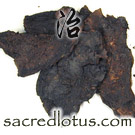 Sheng Di Huang24 gCool the Blood
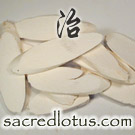 Shan Yao12 gTonify Qi
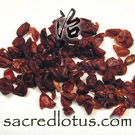 Shan Zhu Yu12 gAstringe, Stabilize, Bind
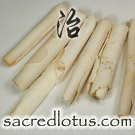 Fu Ling9 gRegulate Water and Drain Dampness
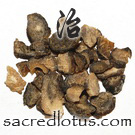 Fu Zi3 gWarm the Interior and Expel Cold
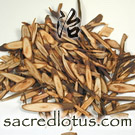 Gui Zhi3 gWarm, Spicy Herbs that Release the Exterior
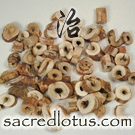 Mu Dan Pi9 gCool the Blood
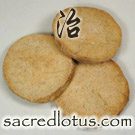 Ze Xie9 gRegulate Water and Drain Dampness
Preparation & dosage
How is Jin Gui Shen Qi Wan prepared?
Classically prepared as a honey pill (wan) ground from the eight herbs, though it is also decocted as a modern granule or raw-herb formula. Fu Zi is always used in its processed (zhi/praeparatus) form, never raw, and is traditionally cooked separately or pre-decocted before the remaining herbs are added, to reduce its toxicity.
Some manufactured patent versions of this formula substitute Shu Di Huang (steamed, "cooked" Rehmannia) for the Sheng Di Huang (raw, dried Rehmannia) used in the original Jin Gui Yao Lue recipe and in our database; Shu Di Huang is more purely Blood/Yin-nourishing and less heat-clearing than Sheng Di Huang, so the two versions differ slightly in emphasis even though both are labeled "Jin Gui Shen Qi Wan."
Source: Bensky & Barolet, Formulas & Strategies; Jin Gui Yao Lue (classical source text).
Safety — read before use
What are the cautions for Jin Gui Shen Qi Wan?
This is a warming formula and is contraindicated in Yin-deficient heat, exuberant fire from Yin deficiency, or any pattern of true heat, and it is not appropriate during pregnancy without professional guidance.
- Avoid in Yin deficiency with heat signs (malar flushing, night sweats, five-palm heat) or in dryness/fluid-impairment patterns, which the formula's warming herbs could aggravate.
- Avoid in damp-heat or phlegm-damp accumulation with a greasy, thick tongue coat, since the warming herbs could worsen heat and the tonics could increase stagnation.
- Not for excess-type edema or urinary difficulty unrelated to Kidney Yang deficiency.
- Fu Zi (Radix Lateralis Praeparatus Aconiti Carmichaeli) is processed aconite, a substance that is toxic in its raw form and restricted in many jurisdictions. It is included here only as processed, pre-detoxified material at a small, tightly controlled dose (3g of 9g total in our database's proportions) — this entry is a public-safety reference, not preparation or dosing guidance, and any use of aconite-containing formulas should be supervised by a qualified practitioner.
Source: Bensky & Barolet, Formulas & Strategies; Chen & Chen, Chinese Herbal Formulas and Applications.
Originally Appeared In:
- Essentials from the Golden Cabinet (Jin Gui Yao Lue)
Notes:
How does Jin Gui Shen Qi Wan differ from Liu Wei Di Huang Wan?
Jin Gui Shen Qi Wan is the historical parent formula of Liu Wei Di Huang Wan: removing its two warming herbs, Gui Zhi and Fu Zi, from the same six-herb Yin/Essence-nourishing base yields Liu Wei Di Huang Wan. Song-dynasty physician Qian Yi is credited with deriving Liu Wei Di Huang Wan from this Han-dynasty formula by dropping the warming pair to create a purely Yin-nourishing pediatric formula, later adopted widely for adult Kidney Yin deficiency.
- Jin Gui Shen Qi Wan treats Kidney Yang deficiency with cold signs (cold limbs, cold lower back/knees, clear profuse urination) using the same three-tonify/three-drain base plus a small warming dose.
- Liu Wei Di Huang Wan treats Kidney Yin deficiency with heat signs (malar flush, night sweats, dry mouth, five-palm heat), using only the three-tonify/three-drain base and typically substituting Shu Di Huang for Sheng Di Huang.
In our database, Jin Gui Shen Qi Wan uses Sheng Di Huang (raw Rehmannia) and Gui Zhi (cinnamon twig), following the original Jin Gui Yao Lue recipe, while our Liu Wei Di Huang Wan entry uses Shu Di Huang (prepared Rehmannia) — the difference in Di Huang processing between the two entries is consistent with each formula's own classical sourcing and is not a data error.
What is Ba Wei Di Huang Wan / Hachimi-jio-gan?
Ba Wei Di Huang Wan ("Eight Ingredient Rehmannia Pill") and the Japanese Kampo formula Hachimi-jio-gan are the same eight-herb prescription as Jin Gui Shen Qi Wan under alternate names used in later Chinese texts and in Japan respectively; research published under these names refers to the identical formula.
Is Rou Gui ever used instead of Gui Zhi in this formula?
Some later patent and clinical versions substitute Rou Gui (cinnamon bark, which more strongly warms the Kidney and anchors floating Yang) for the classical Gui Zhi (cinnamon twig, which also releases the exterior and warms channels). Our database entry uses Gui Zhi, matching the original Jin Gui Yao Lue formula and mainstream Bensky & Barolet sourcing; this is noted here as a known formula variant, not a correction to our data.
Source: Bensky & Barolet, Formulas & Strategies; Chen & Chen, Chinese Herbal Formulas and Applications.
Clinical Studies & Research:
Is there modern research on Jin Gui Shen Qi Wan?
A 2021 systematic review and meta-analysis of 14 clinical studies (1,586 participants) found that adding Jin Gui Shen Qi Wan to standard hypoglycemic therapy improved glucose metabolism markers in people with type 2 diabetes, with evidence for lipid-metabolism effects rated insufficient. Animal research under the formula's alternate Japanese name, Hachimi-jio-gan, has examined its effects on diabetic kidney changes and on differences from its "child" formula Liu Wei Di Huang Wan.
- A rat study of diabetic nephropathy found that Hachimi-jio-gan reduced blood glucose and urinary protein excretion and increased creatinine clearance in a dose-dependent manner, alongside reduced oxidative stress markers.
- A comparative proteomic study in mouse hippocampus found that Jin Gui Shen Qi Wan (Jingui Shenqi) and Liu Wei Di Huang Wan (Liuwei Dihuang) produced distinct, only partly overlapping protein-expression changes, consistent with the two formulas' related but distinct Yang- versus Yin-tonifying actions.
This research is presented as scientific context on a traditional formula, not as a treatment claim; it does not replace individualized diagnosis and care from a qualified practitioner.
Sources: PMID 34552482; PMID 15218322; PMID 35178953.
Sources & References
Compiled and edited by Thomas Dehli, Founder & Editor, Sacred Lotus Updated
The information here is referenced from numerous sources — teachers, practitioners, class notes from Five Branches University, the books below, and the published research literature, with citations given as resolvable PubMed identifiers. Where sources disagree, I have flagged the discrepancies directly. If facts couldn't be verified, I have left them out. How we source our content.
Reference information for students and practitioners — not medical advice. Consult a qualified practitioner. Terms of use.
Chinese Formulas Books & References
 https://amzn.to/4fYI3f8
 https://amzn.to/4j55NRA
 https://amzn.to/4gMROyv
 https://amzn.to/4h7msSK