

Yi Guan Jian (Linking Decoction)
Yi Guan Jian
Linking Decoction
- Category
- Formulas that Tonify
- Subcategory
- Formulas that Nourish and Tonify the Yin
- Ingredients
- 6 herbs
Actions
What does Yi Guan Jian do?
Yi Guan Jian enriches the yin and blood of the Liver and Kidney while spreading (regulating) the Liver qi. It is the classic representative of "nourish the yin to soothe the Liver" — treating Liver qi stagnation that arises from an underlying yin-and-blood deficiency, where drying, aromatic qi-movers alone would only deepen the deficiency.
How the ingredients work together:
- Chief — Sheng Di Huang (largest dose) enriches Liver and Kidney yin and nourishes the blood.
- Deputies — Gou Qi Zi and Dang Gui nourish and enrich Liver blood and yin.
- Assistants — Sha Shen and Mai Men Dong nourish Lung and Stomach yin and generate fluids, supporting the "Metal controls Wood" relationship.
- Envoy — Chuan Lian Zi (small dose) spreads constrained Liver qi and drains Liver heat; being cool and bitter it moves qi without drying the yin.
Source: Bensky & Barolet, Chinese Herbal Medicine: Formulas & Strategies (2nd ed.), Yi Guan Jian entry. Traditional-use framing; not medical advice.
Indications
What is Yi Guan Jian used for?
Yi Guan Jian is used for Liver and Kidney yin deficiency with Liver qi stagnation. The picture is hypochondriac, chest, or epigastric pain and distention alongside signs of yin depletion: a dry, parched mouth and throat, a bitter taste, acid regurgitation, and irritability.
Typical presentation:
- Pain — hypochondriac, chest, and epigastric pain and fullness (the stagnant, deficient Liver).
- Yin-deficiency signs — dry mouth and throat, thirst, a bitter taste, acid reflux.
- Tongue & pulse — a red, dry tongue with little coat; a thin, frail, or deficient and wiry pulse.
It is also applied classically to hernial disorders and abdominal masses that arise on the same yin-deficient, qi-stagnant basis.
Source: Bensky & Barolet, Formulas & Strategies; pattern, tongue, and pulse confirmed against the Sacred Lotus formula record. Traditional-use framing; not medical advice.
Western Uses:
What is Yi Guan Jian used for in modern practice?
In modern reference sources Yi Guan Jian is most associated with chronic liver disorders framed through its yin-nourishing pattern — conditions such as chronic hepatitis, early cirrhosis, and chronic gastritis or reflux where practitioners identify Liver/Kidney yin deficiency with Liver qi stagnation. This is pattern-based reference framing, not a diagnosis-specific treatment claim.
Reported reference associations include:
- Chronic liver disease — chronic hepatitis and early cirrhosis (mirroring the formula's modern research focus on liver fibrosis).
- Upper-digestive complaints — chronic gastritis, reflux, and intercostal or epigastric pain of the deficient-yin type.
Any such use is decided by pattern differentiation, not by the Western label alone.
Source: Bensky & Barolet, Formulas & Strategies (modern applications section). Reference framing only; not a medical claim.
Ingredients
6 substances in Yi Guan Jian — each links to its full herb monograph.
 Sheng Di Huang18-45 gCool the Blood
 Gou Qi Zi9-18 gTonify Blood
 Mai Men Dong9 gTonify YinNo specimen photographSha Shen9 gTonify Yin
 Chuan Lian Zi4.5 gRegulate the Qi
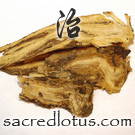 Dang Gui9 gTonify Blood
Preparation & dosage
How is Yi Guan Jian prepared?
Yi Guan Jian ("Linking Decoction") is prepared as a water decoction (tang) of the yin-and-blood-nourishing Sheng Di Huang, Gou Qi Zi, Sha Shen, Mai Men Dong and Dang Gui, with a single small dose of Chuan Lian Zi to gently move constrained Liver qi without drying the yin.
The generous moistening tonics dominate; Chuan Lian Zi is kept to a small amount (it is slightly toxic in excess). Used for Liver-yin deficiency with qi constraint. Available as granules.
Source: Sacred Lotus sources & references (composition and preparation note) + Bensky & Barolet, Formulas & Strategies.
Decoction, taken warm. Typical: Sheng Di Huang 18-45 g, Gou Qi Zi 9-18 g, Dang Gui, Mai Men Dong and Sha Shen 9 g each, Chuan Lian Zi 4.5 g.
Safety — read before use
What are the cautions for Yi Guan Jian?
Yi Guan Jian is rich and enriching, so it is not suited to patterns with dampness, phlegm, or Spleen/Stomach qi deficiency. Its cloying yin tonics can burden a weak digestion, worsening a stifling sensation, poor appetite, loose stools, or a thick, greasy tongue coat.
- Damp/phlegm or weak digestion — use with caution or modification when there is a thick greasy coat, fullness, or loose stools.
- Chuan Lian Zi (Fructus Toosendan) — contains toosendanin and can be hepatotoxic in large or prolonged doses; it is kept to a small dose and used with care, particularly in liver disease.
- Pattern fit — it addresses deficiency-based stagnation; it is not for qi stagnation of a purely excess type.
Source: Bensky & Barolet, Formulas & Strategies (cautions); Chuan Lian Zi toxicity per standard materia medica. Not medical advice; consult a qualified practitioner.
Originally Appeared In:
- Continuation of Famous Physicians' Cases Organized by Categories (Xu Ming Yi Lei An)
Notes:
How does Yi Guan Jian compare to other formulas, and how is it modified?
Yi Guan Jian is the yin-deficient counterpart to Xiao Yao San. Both relieve Liver qi stagnation with hypochondriac pain, but Xiao Yao San targets Liver constraint with Liver blood and Spleen deficiency (using warming, drying qi-movers), whereas Yi Guan Jian is chosen when the constraint sits on a foundation of Liver and Kidney yin depletion with heat signs.
Common comparisons and modifications:
- vs Xiao Yao San — Xiao Yao San for blood/Spleen-deficient constraint; Yi Guan Jian for yin-deficient constraint with a red dry tongue.
- vs Liu Wei Di Huang Wan — both enrich Liver/Kidney yin, but Yi Guan Jian adds the qi-spreading Chuan Lian Zi for accompanying stagnation and pain.
- Marked heat — classically add herbs such as Zhi Zi and Bai Shao.
- Constipation — add moistening seeds such as Gua Lou Ren.
- Strong acid reflux — combine with the Zuo Jin Wan pair (Huang Lian, Wu Zhu Yu).
Source: Bensky & Barolet, Formulas & Strategies (comparisons & modifications). Traditional-use framing; not medical advice.
Clinical Studies & Research:
Is there modern research on Yi Guan Jian?
Modern study is preclinical and centers on liver fibrosis. In rats with DMN-induced fibrosis, Yi Guan Jian lowered serum GOT/GPT and reduced collagen α1-I, TIMP-1 and α-SMA; modified Yi Guan Jian drove hepatic stellate-cell apoptosis via an ROS-mediated pathway. Human data remain limited.
Sources: PubMed 21333722; PMC 2957151. Research context, not a claim.
Sources & References
Compiled and edited by Thomas Dehli, Founder & Editor, Sacred Lotus Updated
The information here is referenced from numerous sources — teachers, practitioners, class notes from Five Branches University, the books below, and the published research literature, with citations given as resolvable PubMed identifiers. Where sources disagree, I have flagged the discrepancies directly. If facts couldn't be verified, I have left them out. How we source our content.
Reference information for students and practitioners — not medical advice. Consult a qualified practitioner. Terms of use.
Chinese Formulas Books & References
 https://amzn.to/4fYI3f8
 https://amzn.to/4j55NRA
 https://amzn.to/4gMROyv
 https://amzn.to/4h7msSK