

Xiao Luo Wan (Reduce Scrofula Pill)
Actions
What does Xiao Luo Wan do?
Xiao Luo Wan (Reduce Scrofula Pill) clears heat, transforms phlegm, softens hardness, and dissipates nodules — a three-herb formula for firm, rubbery lumps in the neck (classically called scrofula, luo li) that form when deficient-yin heat cooks fluids into phlegm and the phlegm binds into masses.
The three ingredients divide by function:
- Xuan Shen is salty, bitter, and cold; it nourishes yin and drains deficiency fire, and its salty taste helps soften hardness at the root of the pattern.
- Mu Li (oyster shell) is salty and astringent; salty-tasting minerals classically soften and break down hardened accumulations, making it central to dissolving the palpable mass itself.
- Zhe Bei Mu is bitter and cold; it clears the heat that has thickened the phlegm and actively transforms and disperses the phlegm-nodules.
Discrepancy: secondary sources disagree on which single herb is "chief" — some name Mu Li chief (citing the salty-softens-hardness principle), others center the analysis on Xuan Shen (yin-nourishing, fire-draining). This site’s own record does not record chief/deputy/assistant flags for this formula, and Bensky-style texts describe the three as acting together rather than in a strict single-chief hierarchy, so no ranking is asserted here.
Source: this site’s own composition record + Bensky & Barolet, Formulas & Strategies, chapter on formulas that transform phlegm and dissipate nodules; cross-referenced against multiple online sources. Traditional-use framing; not medical advice.
Indications
What is Xiao Luo Wan used for?
Xiao Luo Wan treats scrofula — firm, rubbery, generally non-tender nodules along the neck arising from Phlegm-Fire, often on a background of yin deficiency. The classic picture is a chronic, slowly enlarging swelling rather than an acute, painful one.
Its classic clinical presentation:
- Local signs: firm, rubbery neck lumps or chains of nodules; dry mouth and throat; sometimes a bitter taste.
- Underlying pattern: Phlegm-Fire binding, frequently layered on Yin deficiency with empty heat.
- Common applications cited in practitioner references: cervical lymphadenopathy/lymphadenitis, simple goiter, and thyroid nodules or thyroiditis presenting with this pattern.
Tongue and pulse: the tongue is red; the pulse is rapid (also described in some sources as rolling/slippery or wiry, reflecting phlegm and heat).
Source: this site’s own pattern/tongue/pulse record + Bensky & Barolet, Formulas & Strategies; cross-referenced against multiple online sources. Traditional-use framing; not medical advice.
Western Uses:
What is Xiao Luo Wan used for in modern practice?
In modern practice Xiao Luo Wan is referenced for firm neck swellings such as cervical lymphadenopathy, simple goiter, and thyroid nodules — the same territory covered by its traditional "scrofula" indication, since Western medicine also groups swollen lymph nodes and thyroid enlargement together as visible neck masses.
These biomedical correlates are offered as a reference to the formula’s traditional use, not as a claim that it treats any disease. Any new or enlarging neck mass warrants medical evaluation (to rule out infection, thyroid dysfunction, or malignancy) before or alongside any herbal approach. Current research on this specific formula is preclinical only (see research) — there is no clinical-trial evidence cited here.
Source: traditional-use correlates summarized from Bensky & Barolet, Formulas & Strategies, and multiple online sources; reference only, not a treatment claim.
Ingredients
3 substances in Xiao Luo Wan — each links to its full herb monograph.
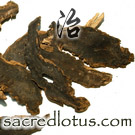 Xuan Shen9-12 gCool the Blood
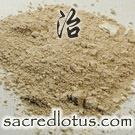 Mu Li9-12 gAnchor, Settle, and Calm the Spirit
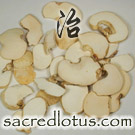 Zhe Bei Mu9-12 gCool and Transform Phlegm-Heat
Preparation & dosage
How is Xiao Luo Wan prepared?
Classically prepared as a decoction of the three herbs (this site’s own record confirms "Decoction"); the formula's name (wan, "pill") reflects its traditional preparation as a fine powder formed into pills, which some sources still list alongside the decoction method. Because Mu Li (oyster shell) is a mineral/shell substance, it is conventionally added to the pot first and pre-decocted for roughly 20–30 minutes before the other two herbs are added, to help extract its minerals fully.
Source: this site’s own preparation record + general Chinese-herbal decoction convention for shell/mineral substances (Mu Li), cross-referenced against multiple online sources preparation notes. Reference only.
Decoction (or traditionally, powdered and formed into honey pills). Reference relative amounts, roughly equal-to-Mu-Li-weighted parts: Xuan Shen 9-12 g; Mu Li 9-12 g (some sources weight Mu Li slightly higher, e.g. ~40% of the total vs ~30% each for the other two); Zhe Bei Mu 9-12 g. Mu Li is conventionally pre-decocted 20-30 minutes before adding the other herbs. Reference only; not a prescription.
Safety — read before use
What are the cautions for Xiao Luo Wan?
Xiao Luo Wan is a cold, heat-clearing formula, so it is contraindicated for nodules due to cold (congealing from cold rather than phlegm-fire). Using it against a cold-type mass would be a pattern mismatch.
- Contraindicated in cold-congealing nodules — reserve for the Phlegm-Fire pattern (red tongue, rapid pulse, firm/rubbery lumps).
- Digestive caution: Mu Li is a cold, heavy mineral substance; use cautiously with a weak or cold Spleen/Stomach, where it can be harder to digest.
- Any neck mass should be medically evaluated to rule out infection, thyroid dysfunction, or malignancy before or alongside herbal treatment; this formula is not a substitute for that evaluation.
Source: Bensky & Barolet, Formulas & Strategies and multiple online sources (contraindication for cold-type nodules). Traditional-use framing; not medical advice.
Originally Appeared In:
- Medical Revelations (Yi Xue Xin Wu)
Notes:
How does Xiao Luo Wan compare to other phlegm-nodule formulas?
Xiao Luo Wan is one of the simplest formulas in the "transform phlegm, dissipate nodules" group — just three herbs focused on Phlegm-Fire with an underlying yin-deficiency root. Related formulas expand or shift the strategy:
- vs Xia Ku Cao Gao (Prunella Syrup): Xia Ku Cao Gao has stronger dispersing and heat-clearing action; it is often chosen when heat/fire is more prominent than yin deficiency.
- vs Nei Xiao Luo Li Wan (a larger, related patent formula): that formula adds more phlegm-transforming, heat-clearing, and blood-moving herbs around a similar core (it commonly includes Xuan Shen and Zhe Bei Mu among a longer herb list) for more stubborn or larger nodules; it is a different, more complex formula from Xiao Luo Wan, not a synonym for it.
Discrepancy/naming caution: some online formula databases list a formula also named "Xiao Luo Wan" (消瘰丸) from Zhang Xichun's Yi Xue Zhong Zhong Can Xi Lu (1909) — a ten-herb formula (oyster shell, huang qi, san leng, e zhu, xue jie, ru xiang, mo yao, long dan, xuan shen, zhe bei mu) that shares the name but not the composition. It is a different formula from the one in this site’s own record entry (Xuan Shen + Mu Li + Zhe Bei Mu only, from Yi Xue Xin Wu) and was not used as a source for any field here.
Source: multiple online sources (Xia Ku Cao Gao comparison; Nei Xiao Luo Li Wan composition; and, flagged as a separate source not used for content, the Zhang Xichun formula).
Clinical Studies & Research:
Is there modern research on Xiao Luo Wan?
Yes, but it is preclinical only — animal, cell, and network-pharmacology studies, with no clinical trials identified for this specific formula. Research clusters around two applications: goiter/thyroid conditions (matching its traditional scrofula/nodule use) and, separately, uterine fibroids.
- Goiter with hypothyroidism (rat model): in propylthiouracil-induced goiter, Xiao-Luo-Wan raised T3/T4, lowered TSH, reduced goiter size, and promoted thyroid follicle recovery; network pharmacology implicated PI3K-AKT/RAS signaling (PMID 35101570).
- Thyroid-associated ophthalmopathy (rat model): in L-thyroxine-induced hyperthyroidism, Xiaoluo Wan reduced extraocular muscle injury, possibly via inhibiting oxidative stress through HIF1 signaling (PMID 40696458 / PMC 12281869).
- Uterine fibroids (network pharmacology + cell assays): active components were linked to inhibited fibroid-cell proliferation and promoted apoptosis via TRIM9, NF-κB, and p38MAPK (PMID 40219728); an earlier network-pharmacology study proposed calcium-signaling, MAPK, and cAMP pathway targets for the same indication (PMID 33196098).
Sources: PubMed 35101570; PubMed 40696458 / PMC 12281869; PubMed 40219728; PubMed 33196098. Research context, not a therapeutic claim; all studies are preclinical (animal/cell/computational), with no clinical trials identified for this specific formula.
Sources & References
Compiled and edited by Thomas Dehli, Founder & Editor, Sacred Lotus Updated
The information here is referenced from numerous sources — teachers, practitioners, class notes from Five Branches University, the books below, and the published research literature, with citations given as resolvable PubMed identifiers. Where sources disagree, I have flagged the discrepancies directly. If facts couldn't be verified, I have left them out. How we source our content.
Reference information for students and practitioners — not medical advice. Consult a qualified practitioner. Terms of use.
Chinese Formulas Books & References
 https://amzn.to/4fYI3f8
 https://amzn.to/4j55NRA
 https://amzn.to/4gMROyv
 https://amzn.to/4h7msSK