

Yue Ju Wan (Escape Restraint Pill)
Yue Ju Wan
Escape Restraint Pill
- Category
- Formulas that Regulate the Qi
- Subcategory
- Formulas that Promote the Movement of Qi
- Ingredients
- 5 herbs
Actions
What does Yue Ju Wan do?
Yue Ju Wan (Escape Restraint Pill) relieves the “six stagnations” (liu yu) — of qi, blood, dampness, phlegm, food, and fire — by treating qi stagnation as the root from which the other five commonly follow. Rather than a separate herb for each stagnation, it opens the Liver’s qi-moving function first, on the reasoning (from its author Zhu Dan-xi) that once qi flows again, blood, fluids, and food that had backed up behind it tend to move on their own.
- Moves qi and resolves constraint: Xiang Fu unblocks Liver qi stagnation, the formula’s organizing action.
- Invigorates blood: Chuan Xiong moves qi and blood together, addressing stagnation that has begun to affect the blood level.
- Dries dampness: Cang Zhu strengthens the Spleen’s transformation of fluids where stagnant qi has allowed dampness to collect.
- Clears fire: Zhi Zi drains the heat that forms when stagnant qi smolders over time (“qi stagnation transforming into fire”).
- Resolves food stagnation: Shen Qu disperses food accumulation that stalls once the qi dynamic driving digestion is blocked.
Source: Sacred Lotus sources & references (composition) + Bensky & Barolet, Formulas & Strategies; Chen & Chen, Chinese Medical Herbology and Pharmacology (role analysis).
Indications
What is Yue Ju Wan used for?
Yue Ju Wan treats the “six stagnations” pattern — qi stagnation, usually from emotional constraint, that has gone on to entangle blood, dampness, phlegm, food, and heat. It is used broadly for functional digestive and mood-related complaints that flare with stress and center on distention rather than pain from a fixed lesion.
- Epigastric and abdominal distention or fullness, often worse with emotional stress
- Chest and hypochondriac (rib-side) distention and discomfort
- Belching, acid regurgitation, nausea, and reduced appetite
- Indigestion with a sense of food sitting undigested
- Irregular or painful menstruation and breast distention tied to Liver qi constraint
- Occasional cough with copious sputum where phlegm has formed alongside the stagnation
Source: Sacred Lotus sources & references (pattern/indications fields) + Bensky & Barolet, Formulas & Strategies.
Western Uses:
What conditions is Yue Ju Wan used for in modern practice?
Yue Ju Wan resolves the "six stagnations" — qi constraint dragging blood, damp, phlegm, food and fire into stagnation together (epigastric and flank fullness, distention, belching, and a stuck, oppressed feeling), so it is referenced for stagnation-type digestive and hepatobiliary conditions: gastro-intestinal neurosis, gastric or duodenal ulcer, chronic gastritis, infectious hepatitis, cholecystitis, gallstones (cholecystolithiasis), and intercostal neuralgia.
It is chosen for the six-stagnations pattern, not for a diagnosis. Ulcers need medical treatment (including H. pylori testing), hepatitis and gallbladder disease require diagnosis, and acute cholecystitis can be a surgical emergency. Traditional-use correlates only, not a treatment claim.
Source: Sacred Lotus sources & references (pattern) + Bensky & Barolet, Formulas & Strategies; biomedical correlates as reference only. Not medical advice.
Ingredients
5 substances in Yue Ju Wan — each links to its full herb monograph.
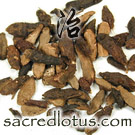 Xiang Fu6-12 gRegulate the Qi
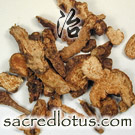 Cang Zhu6-12 gAromatic Herbs that Transform and Dissolve Dampness
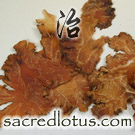 Chuan Xiong6-12 gInvigorate Blood and Remove Stagnation
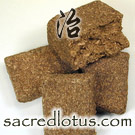 Shen Qu6-12 gRelieve Food Stagnation
 Zhi Zi6-12 gDrain Fire
Preparation & dosage
How is Yue Ju Wan prepared?
Classically prepared as a pill (wan), as the formula’s name states — the five herbs are ground to a fine powder in equal proportions and formed into pills, traditionally taken with warm water or a mild tea; in modern clinical practice it is very commonly decocted instead, which is the form the reference amounts below assume.
- Reference decoction amounts (from Sacred Lotus composition data): Cang Zhu, Chuan Xiong, Xiang Fu, Zhi Zi, and Shen Qu are each used at roughly 6–12 g, reflecting the formula’s traditional equal-parts pill ratio.
- Equal-parts principle: the classical instruction is to combine the five herbs in equal amounts, since no single stagnation is assumed in advance to dominate — the practitioner then adjusts proportions once the leading stagnation is identified in a given patient.
- Common modification: when a particular one of the six stagnations clearly predominates (for example pronounced heat or pronounced phlegm), its corresponding herb is often increased or supporting herbs added.
Source: Sacred Lotus sources & references (composition/dosage) + Bensky & Barolet, Formulas & Strategies (traditional pill preparation and equal-parts convention).
Safety — read before use
What are the cautions for Yue Ju Wan?
Yue Ju Wan is a dispersing formula for excess-type stagnation and is not appropriate for qi stagnation arising from underlying deficiency — where fatigue, a weak pulse, and a pale tongue point to insufficient qi or blood rather than a blockage of qi that is otherwise adequate. Using purely moving, draining herbs against a deficient root can worsen fatigue instead of relieving distention.
- Not for qi stagnation from deficiency: a tonifying strategy, not this dispersing one, is indicated when weakness underlies the stagnation.
- Pregnancy: contains blood-invigorating herbs (Chuan Xiong) — use only under professional guidance.
- Duration of use: as a dispersing formula built for an active stagnation pattern, it is traditionally used for a defined course rather than long-term, and is reassessed once distention resolves.
Source: Sacred Lotus sources & references (cautions field) + Bensky & Barolet, Formulas & Strategies (pattern appropriateness for dispersing formulas).
Originally Appeared In:
- Teachings of Dan Xi (Dan Xi Xin Fa)
Notes:
How does Yue Ju Wan differ from Chai Hu Shu Gan San and Xiao Yao San?
Yue Ju Wan is the broadest of the three, built to unknot up to six overlapping stagnations at once, whereas Chai Hu Shu Gan San and Xiao Yao San are more targeted Liver-qi formulas for presentations where qi constraint has not yet generated as many secondary problems.
- vs Chai Hu Shu Gan San: that formula centers on Chai Hu and a fuller set of qi-moving herbs (Chen Pi, Xiang Fu, Chuan Xiong, Zhi Ke, Bai Shao) for classic Liver-qi-stagnation chest and hypochondriac pain, without Yue Ju Wan’s dedicated anti-damp (Cang Zhu), anti-fire (Zhi Zi), and anti-food-stagnation (Shen Qu) herbs.
- vs Xiao Yao San (Rambling Powder): Xiao Yao San combines Liver-qi movement with Spleen tonification and blood nourishment (Bai Zhu, Fu Ling, Dang Gui, Bai Shao) — appropriate when Liver constraint overlaps with an underlying Spleen-qi or blood deficiency, a very different root from the six-stagnations, largely excess pattern Yue Ju Wan addresses.
Classical source and lineage: Yue Ju Wan comes from Dan Xi Xin Fa (“Teachings of [Zhu] Dan-xi”), compiled by the students of Zhu Dan-xi (1281–1358), one of the “Four Great Masters” of Jin-Yuan dynasty medicine and a principal architect of the theory that emotional constraint drives qi stagnation, which in turn can generate heat, dampness, phlegm, blood stasis, and food stagnation in sequence. The formula is also known as Zhi Ju Wan and Liu Yu Wan (“Six Stagnations Pill”).
Source: Bensky & Barolet, Formulas & Strategies (formula comparisons, classical source, alternate names).
Clinical Studies & Research:
Is there modern research on Yue Ju Wan?
Yes — Yue Ju Wan (often romanized “Yueju pill” in the research literature) has an active, ongoing preclinical and early clinical research program focused on rapid antidepressant-like effects, led largely by one Chinese research group. Animal studies report that Yueju produces fast-onset, ketamine-like antidepressant effects in rodent models, and recent work has begun to translate this toward human major depressive disorder.
- Rapid antidepressant-like effect and BDNF (preclinical): a single dose of Yueju rapidly reduced depression-like behavior in mice and acutely raised hippocampal BDNF expression, with effects resembling but distinct from ketamine (PMID 23710213).
- NMDA receptor / nitric oxide pathway (preclinical): Yueju’s antidepressant-like effect in mice was linked to NMDA receptors and the L-arginine/nitric oxide/cGMP signaling pathway (PMID 31467174).
- Neural plasticity in a chronic stress model (preclinical): repeated low-dose Yueju produced antidepressant effects in a learned-helplessness mouse model via hippocampal PKA-CREB and NMDA signaling (PMID 29075536).
- Clinical translation (human, 2025): a study of escitalopram versus Yueju Pill in major depressive disorder examined brain-network predictors of symptom change and serum BDNF (PMID 41098595).
- Review: a 2017 review summarizes the rapid-antidepressant research program and proposed mechanisms (PMID 28347831).
Sources: PMID 23710213; PMID 31467174; PMID 29075536; PMID 41098595; PMID 28347831. Predominantly preclinical (rodent) research with early clinical translation; research context, not a therapeutic claim.
Sources & References
Compiled and edited by Thomas Dehli, Founder & Editor, Sacred Lotus Updated
The information here is referenced from numerous sources — teachers, practitioners, class notes from Five Branches University, the books below, and the published research literature, with citations given as resolvable PubMed identifiers. Where sources disagree, I have flagged the discrepancies directly. If facts couldn't be verified, I have left them out. How we source our content.
Reference information for students and practitioners — not medical advice. Consult a qualified practitioner. Terms of use.
Chinese Formulas Books & References
 https://amzn.to/4fYI3f8
 https://amzn.to/4j55NRA
 https://amzn.to/4gMROyv
 https://amzn.to/4h7msSK