

Ban Xia Hou Po Tang (Pinellia and Magnolia Bark Decoction)
Ban Xia Hou Po Tang Bàn Xià Hòu Pò Tāng
Pinellia and Magnolia Bark Decoction
- Category
- Formulas that Regulate the Qi
- Subcategory
- Formulas that Promote the Movement of Qi
- Ingredients
- 5 herbs
Actions
What does Ban Xia Hou Po Tang do?
Ban Xia Hou Po Tang (Pinellia and Magnolia Bark Decoction) moves constrained qi and disperses the phlegm that has congealed with it, relieving the sensation of something stuck in the throat that will neither swallow down nor cough up. It works by dispersing and descending, not by tonifying: aromatic, drying, and downward-moving herbs open a physical-feeling obstruction that classical medicine attributed to qi and phlegm binding together in the throat, rather than to any deficiency needing to be built up.
- Moves qi and disperses nodulation: Hou Po and Zi Su Ye open the constrained qi in the chest and throat that phlegm has bound around.
- Directs rebellious qi downward: Ban Xia and Sheng Jiang descend Stomach and Lung qi, easing nausea, vomiting, and the sense of blockage.
- Dries dampness and transforms phlegm: Ban Xia, supported by Fu Ling, dries the damp that has thickened into phlegm.
- Strengthens the Spleen and leaches dampness: Fu Ling addresses the source of damp accumulation so phlegm is less likely to reform.
Source: Sacred Lotus sources & references (composition) + Bensky & Barolet, Formulas & Strategies; Chen & Chen, Chinese Medical Herbology and Pharmacology.
Indications
What is Ban Xia Hou Po Tang used for?
Ban Xia Hou Po Tang treats “plum-pit qi” (mei he qi) — a subjective sensation of something lodged in the throat, most often triggered or worsened by emotional upset, that arises from Liver qi stagnation binding with phlegm rather than from any physical mass. It is the classic formula for this globus-type presentation and its accompanying chest symptoms.
- A persistent feeling of something stuck in the throat that cannot be swallowed or coughed up (plum-pit qi / globus sensation), often worse with stress
- A sensation of fullness, oppression, or stifling tightness in the chest and hypochondriac (rib-side) region
- Cough with copious white, watery, or foamy sputum
- Nausea and vomiting associated with rebellious Stomach qi
- A feeling of a lump in the throat accompanying respiratory complaints
Source: Sacred Lotus sources & references (pattern/indications fields) + Bensky & Barolet, Formulas & Strategies.
Western Uses:
What conditions is Ban Xia Hou Po Tang used for in modern practice?
Ban Xia Hou Po Tang treats "plum-pit qi" — the sensation of a lump in the throat that will neither swallow nor cough up, from qi and phlegm binding — so it is referenced where that sensation and qi-constraint appear: globus sensation (globus hystericus), a functional/"nervous" gastro-intestinal picture, oesophageal spasm, chronic laryngitis, and tracheitis.
It is chosen for the qi-and-phlegm constraint pattern, not for a diagnosis. A persistent lump-in-the-throat sensation, or any genuine difficulty swallowing, must be medically assessed — while often benign (globus), dysphagia can signal serious disease of the throat or oesophagus. Traditional-use correlates only, not a treatment claim.
Source: Sacred Lotus sources & references (pattern) + Bensky & Barolet, Formulas & Strategies; Chen & Chen, Chinese Medical Herbology and Pharmacology. Biomedical correlates as reference only; not medical advice.
Ingredients
5 substances in Ban Xia Hou Po Tang — each links to its full herb monograph.
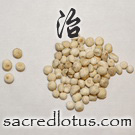 Ban Xia9-12 gWarm Herbs that Transform Phlegm-Cold
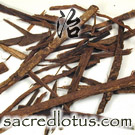 Hou Po9 gAromatic Herbs that Transform and Dissolve Dampness
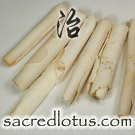 Fu Ling12 gRegulate Water and Drain Dampness
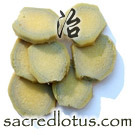 Sheng Jiang9 gWarm, Spicy Herbs that Release the Exterior
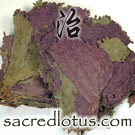 Zi Su Ye6 gWarm, Spicy Herbs that Release the Exterior
Preparation & dosage
How is Ban Xia Hou Po Tang prepared?
Prepared as a decoction (tang), as its name states — the five herbs are simmered together and the strained liquid taken warm, traditionally in small, divided doses through the day rather than as one large dose, to keep the aromatic, dispersing action working steadily on the throat and chest.
- Reference decoction amounts (from Sacred Lotus composition data): Ban Xia 9–12 g; Hou Po 9 g; Fu Ling 12 g; Sheng Jiang 9 g; Zi Su Ye 6 g.
- Herb processing: Ban Xia is always used in a processed (zhi) form — ginger-processed (jiang Ban Xia) is traditional here — never raw, to remove its irritant toxicity; Sheng Jiang is used fresh and uncooked, both moderating Ban Xia’s toxicity and adding its own downward-directing action.
- Classical dosing pattern: the source text describes taking the decoction in four small doses across a day and night, consistent with a formula meant to be dispersed gently and repeatedly rather than pushed all at once.
Source: Sacred Lotus sources & references (composition/dosage) + Bensky & Barolet, Formulas & Strategies (classical preparation and herb processing).
Safety — read before use
What are the cautions for Ban Xia Hou Po Tang?
Ban Xia Hou Po Tang is warm, drying, and dispersing, so it is unsuitable for a throat or chest sensation rooted in Yin deficiency with heat rather than in qi-phlegm stagnation — using its acrid, drying herbs against a dry, deficient-heat throat can aggravate rather than relieve the sensation.
- Not for Yin-deficient patients: avoid where there is a bitter taste in the mouth, a flushed face, and a red tongue with little or no coating — signs of deficiency-heat rather than qi-phlegm binding.
- Not for dry, deficiency-type throat discomfort: its warm, drying herbs can worsen dryness if the underlying pattern is fluid or Yin deficiency instead of phlegm-damp stagnation.
- Ban Xia is classically listed among the “eighteen incompatibilities” (shi ba fan) as incompatible with aconite-type herbs (Wu Tou/Fu Zi); noted here as neutral public-safety reference on traditional herb-pairing restrictions, not as administration guidance.
Source: Sacred Lotus sources & references (cautions field) + Bensky & Barolet, Formulas & Strategies (pattern appropriateness); classical “eighteen incompatibilities” (shi ba fan) convention for Ban Xia.
Originally Appeared In:
- Essentials from the Golden Cabinet (Jin Gui Yao Lue)
Notes:
How does Ban Xia Hou Po Tang differ from Si Qi Tang and Xiao Chai Hu Tang?
Ban Xia Hou Po Tang is the base formula for plum-pit qi built purely from dispersing, phlegm-transforming herbs, while Si Qi Tang is a later variant with added Spleen-tonifying herbs, and Xiao Chai Hu Tang addresses a different, Shaoyang-stage mechanism that can present with similar chest fullness.
- vs Si Qi Tang (“Four Seven Decoction”): adds Bai Zhu and Gan Cao (and sometimes Da Zao) to Ban Xia Hou Po Tang’s core, giving mild Spleen-qi support alongside the same qi-moving, phlegm-dispersing action — useful when a degree of underlying Spleen weakness accompanies the plum-pit pattern.
- vs Xiao Chai Hu Tang: that formula harmonizes Shaoyang-stage alternating chills and fever and chest-and-flank fullness using Chai Hu and Huang Qin, a different mechanism (half-exterior/half-interior heat) from the qi-phlegm binding Ban Xia Hou Po Tang targets; the two are occasionally combined when both patterns overlap.
Classical source and lineage: Ban Xia Hou Po Tang comes from the Jin Gui Yao Lue (“Essential Prescriptions of the Golden Cabinet”), attributed to Zhang Zhong-jing (Han dynasty), where it is described for a woman with the sensation of a piece of roasted meat (or a plum pit) stuck in the throat — the origin of the term “plum-pit qi” (mei he qi) still used for globus sensation today. In Japanese Kampo medicine the same formula is known as hangekobokuto and remains widely used and studied.
Source: Bensky & Barolet, Formulas & Strategies (classical source, formula comparisons, Kampo usage).
Clinical Studies & Research:
Is there modern research on Ban Xia Hou Po Tang?
Yes — under its Japanese Kampo name hangekobokuto, this formula has a meaningful body of clinical research, concentrated on two areas: relief of throat globus sensation and, notably, prevention of aspiration pneumonia in patients with impaired swallowing. These are the best-studied modern applications of a formula whose traditional indication was already a throat/swallowing complaint.
- Aspiration pneumonia prevention (clinical, RCT): a double-blind, placebo-controlled trial in cardiovascular surgery patients found hangekobokuto significantly reduced aspiration pneumonia rates, with a larger effect in patients at high baseline risk (PMID 31316037).
- Throat globus sensation (clinical): a study in patients with respiratory disease found two weeks of hangekobokuto improved the subjective sensation of a lump in the throat (PMID 26998281).
- Functional dyspepsia (clinical/review): hangekobokuto has been studied as a Kampo treatment for functional dyspepsia, consistent with its traditional qi-descending, anti-nausea action (PMID 18955239).
- Postoperative ileus (preclinical): hangekobokuto ameliorated postoperative ileus in an experimental model through an anti-inflammatory mechanism (PMID 36216552).
Sources: PMID 31316037; PMID 26998281; PMID 18955239; PMID 36216552. Research on the Japanese Kampo formulation (hangekobokuto), offered as context for this formula’s traditional use — not a therapeutic claim.
Sources & References
Compiled and edited by Thomas Dehli, Founder & Editor, Sacred Lotus Updated
The information here is referenced from numerous sources — teachers, practitioners, class notes from Five Branches University, the books below, and the published research literature, with citations given as resolvable PubMed identifiers. Where sources disagree, I have flagged the discrepancies directly. If facts couldn't be verified, I have left them out. How we source our content.
Reference information for students and practitioners — not medical advice. Consult a qualified practitioner. Terms of use.
Chinese Formulas Books & References
 https://amzn.to/4fYI3f8
 https://amzn.to/4j55NRA
 https://amzn.to/4gMROyv
 https://amzn.to/4h7msSK