

An Gong Niu Huang Wan (Calm the Palace Pill with Cattle Gallstone)
An Gong Niu Huang Wan Ān Gōng Niú Huáng Wán
Calm the Palace Pill with Cattle Gallstone
- Category
- Formulas that Open the Orifices
- Subcategory
- Formulas that Clear Heat and Open the Orifices
- Ingredients
- 11 herbs
Actions
What does An Gong Niu Huang Wan do?
An Gong Niu Huang Wan clears heat, resolves toxin, transforms phlegm, and opens the sensory orifices — it is one of the three classic Wen Bing "orifice-opening" formulas (san bao, the "three treasures") reserved for the most severe stage of a febrile disease, when heat-toxin and phlegm together block the pericardium and consciousness is lost.
- Clears heat and resolves fire-toxin: Huang Lian, Huang Qin, and Zhi Zi (a bitter-cold trio) drain fire from all three burners.
- Opens the orifices (kai qiao): the aromatic pair She Xiang (musk) and Bing Pian (borneol) penetrate through phlegm-misting to rouse consciousness.
- Transforms phlegm and resolves toxin: Niu Huang (chief) and Xiong Huang together clear phlegm-heat and detoxify.
- Cools the blood and calms the spirit: the horn ingredient together with Yu Jin cools blood and moves stasis, while Zhu Sha and Zhen Zhu anchor and settle a spirit disturbed by heat.
Source: Sacred Lotus sources & references (composition) + Bensky & Barolet, Formulas & Strategies; Chen & Chen, Chinese Medical Herbology and Pharmacology. Traditional-use framing; not medical advice.
Indications
What is An Gong Niu Huang Wan used for?
An Gong Niu Huang Wan is reserved for the severe, orifice-blocking stage of a febrile (warm) disease — heat-toxin and phlegm obstructing the Pericardium with loss of consciousness — and is traditionally not used for milder heat patterns that have not reached this depth.
- Loss of consciousness or coma occurring during a high fever
- Delirium, extreme agitation, or disorientation accompanying severe febrile illness
- Childhood convulsions (high fever seizures) with a pattern of phlegm-heat
- Sudden collapse and unconsciousness attributed in traditional practice to Wind-Stroke
- A red or deep-red, sometimes stiff, tongue with a rapid pulse, reflecting heat-toxin at its most severe
Source: Sacred Lotus sources & references (pattern/tongue/pulse fields) + Bensky & Barolet, Formulas & Strategies. Traditional-use framing; not medical advice. This is a description of a classical severe-pattern indication, not guidance for managing an acute medical emergency, which always requires immediate professional care.
Ingredients
11 substances in An Gong Niu Huang Wan — each links to its full herb monograph.
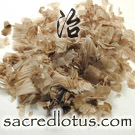 Xi Jiao30 gCool the Blood
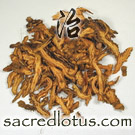 Huang Lian30 gClear Heat and Dry Dampness
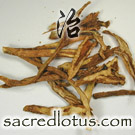 Huang Qin30 gClear Heat and Dry Dampness
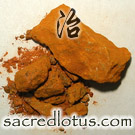 Xiong Huang30 gSubstances for External Application
 Zhi Zi30 gDrain Fire
 Bing Pian7.5 gAromatic Substances that Open the Orifices
 Yu Jin30 gInvigorate Blood and Remove StagnationNo specimen photographZhen Zhu15 gAnchor, Settle, and Calm the SpiritNo specimen photographZhu Sha30 gAnchor, Settle, and Calm the Spirit
Preparation & dosage
How is An Gong Niu Huang Wan prepared?
An Gong Niu Huang Wan is classically a pill (wan): the mineral and herbal ingredients are ground to a fine powder and bound with honey, traditionally coated in gold foil (jin bo) as an outer "clothing" said to further calm the spirit and help preserve the potency of the aromatic ingredients — a detail recorded in the formula's classical description though not always retained in modern manufacture.
- Administration in an unconscious patient: classical and modern hospital-era accounts describe the pill being dissolved or dispersed in warm boiled water so it can be given by spoon or via a feeding tube when the patient cannot swallow directly.
- Aromatic ingredients: She Xiang and Bing Pian are volatile; the pill form (rather than a boiled decoction) is specifically suited to preserving their aromatic, orifice-opening properties.
Source: Bensky & Barolet, Formulas & Strategies (classical pill form, gold-foil coating, and rationale for aromatic ingredients).
Safety — read before use
What are the cautions for An Gong Niu Huang Wan?
An Gong Niu Huang Wan's classical composition contains three ingredients that carry documented modern public-safety and conservation significance; this is presented as neutral reference information, not administration guidance.
- Zhu Sha (Cinnabar, mercury sulfide, HgS): a mercury-containing mineral. Modern toxicology studies have examined hepatorenal effects of cinnabar within An Gong Niu Huang Wan and comparable formulas, and cinnabar-containing products are subject to import restriction in a number of jurisdictions.
- Xiong Huang (Realgar, arsenic sulfide, As4S4): an arsenic-containing mineral, likewise studied for hepatorenal toxicity when present in this formula, and similarly restricted in several regulatory regimes.
- Xi Jiao (Cornu Rhinoceri, rhinoceros horn): the classical ingredient named in Sacred Lotus's composition record reflects the formula's traditional/historical materia medica name. Rhinoceros has been listed on CITES Appendix I since 1977 (international commercial trade effectively banned since 1993), and all legally compliant modern commercial production substitutes water buffalo horn (Shui Niu Jiao, Cornu Bubali) — this is documented here as a conservation-law reference point, not a sourcing recommendation.
- General: traditionally contraindicated in pregnancy and in "collapse" patterns of devastated yang (cold limbs, profuse sweating, a faint/weak pulse) as distinct from the heat-closed ("bi") pattern it is designed for; not intended for repeated or prolonged dosing.
Source: PMID 21094152; PMID 21321321; PMID 25829099; PMID 21435368; PMID 29203196; PMID 33868437; PMID 26162343 (cinnabar/realgar toxicology and safety studies on An Gong Niu Huang Wan); PMID 28864167 (review of cinnabar- and realgar-containing traditional medicines); CITES Appendix I listing (rhinoceros, international trade restriction). Neutral public-safety/conservation reference; not administration guidance or a recommendation to use or avoid any product.
Originally Appeared In:
- Systematic Differentiation of Warm Diseases (Wen Bing Tiao Bian)
Notes:
How does An Gong Niu Huang Wan differ from Zi Xue Dan and Zhi Bao Dan?
An Gong Niu Huang Wan is one of the Wen Bing "Three Treasures" (san bao) — three orifice-opening formulas from the same classical source, distinguished by emphasis.
- vs Zi Xue Dan (Purple Snow Special Pill): more strongly cooling and better suited to heat-toxin with convulsion or wind-stirring; traditionally includes an antelope-horn ingredient rather than An Gong Niu Huang Wan's musk-forward orifice-opening emphasis.
- vs Zhi Bao Dan (Greatest Treasure Special Pill): places more weight on transforming phlegm, and classically includes additional animal-derived ingredients (such as amber and hawksbill turtle shell) that carry their own conservation considerations, paralleling the rhinoceros-horn issue noted above.
Classical source: all three come from the Wen Bing Tiao Bian (Systematic Differentiation of Warm Diseases), Wu Ju-Tong (Wu Jutang), 1798 — the foundational text of the Warm Disease (Wen Bing) school, where they are grouped as the standard treatments for heat-toxin and phlegm blocking the Pericardium.
Contemporary hospital-based research: modern Chinese research has studied An Gong Niu Huang Wan as an adjunct intervention in models of cerebral ischemic stroke and related cerebrovascular disturbance, exploring mechanisms such as cerebral blood flow, neuroinflammation, and apoptosis pathways — preclinical/mechanistic work that reflects contemporary hospital interest in the formula rather than an established human clinical indication.
Source: Bensky & Barolet, Formulas & Strategies (Three Treasures comparison; classical source); PMID 42208106; PMID 38778375; PMID 33935731; PMID 24690773; PMID 38467317 (preclinical/mechanistic stroke and coma-model research). Research context, not a therapeutic claim.
Clinical Studies & Research:
Is there modern research on An Gong Niu Huang Wan?
Yes — research falls into two distinct tracks: heavy-metal safety/toxicology studies of its mineral ingredients, and preclinical stroke/coma-model studies of the whole formula. Both are summarized here as research context, not as evidence of efficacy for any human disease.
- Safety/toxicology of cinnabar and realgar within the formula: studies have examined hepatorenal toxicity, comparative acute/chronic toxicity against simple arsenic and mercury compounds, and arsenic/mercury monitoring during manufacture (PMID 21094152; PMID 21321321; PMID 25829099; PMID 21435368; PMID 29203196; PMID 33868437; PMID 26162343; PMID 29950994).
- Preclinical cerebral ischemia/stroke research: mechanistic studies in animal models have examined cerebral blood flow, neurovascular effects, and apoptosis-pathway markers (Bcl-2/Bax/caspase-3) (PMID 42208106; PMID 38778375; PMID 33935731; PMID 24690773).
- Arousal effects in coma models: an EEG-based study examined arousal effects in alcohol-induced coma in rats (PMID 38467317).
Sources: PMID 21094152; PMID 21321321; PMID 25829099; PMID 21435368; PMID 29203196; PMID 33868437; PMID 26162343; PMID 29950994; PMID 42208106; PMID 38778375; PMID 33935731; PMID 24690773; PMID 38467317. Research context only, mostly preclinical/mechanistic; not a therapeutic claim.
Sources & References
Compiled and edited by Thomas Dehli, Founder & Editor, Sacred Lotus Updated
The information here is referenced from numerous sources — teachers, practitioners, class notes from Five Branches University, the books below, and the published research literature, with citations given as resolvable PubMed identifiers. Where sources disagree, I have flagged the discrepancies directly. If facts couldn't be verified, I have left them out. How we source our content.
Reference information for students and practitioners — not medical advice. Consult a qualified practitioner. Terms of use.
Chinese Formulas Books & References
 https://amzn.to/4fYI3f8
 https://amzn.to/4j55NRA
 https://amzn.to/4gMROyv
 https://amzn.to/4h7msSK