

Ding Zhi Wan (Settle the Emotions Pill)
Actions
What does Ding Zhi Wan do?
Ding Zhi Wan (Settle the Emotions Pill) tonifies Heart qi, calms the spirit (an shen), and opens the Heart’s sensory orifices while resolving phlegm. It is built for a person whose Heart qi is too weak to anchor the Shen (spirit) and whose thinking is further clouded by phlegm turbidity — the combination behind timidity, fright, and forgetfulness.
The four ingredients divide by role:
- Chief: Ren Shen — powerfully tonifies Heart (and Source) qi, addressing the root deficiency.
- Deputy: Fu Ling (Fu Shen may substitute) — strengthens the Spleen to cut off the source of phlegm production, and helps quiet the Heart.
- Assistants: Shi Chang Pu and Yuan Zhi, a classic paired combination — open the Heart orifices, resolve phlegm misting the mind, and sharpen memory and concentration.
Source: this site’s own composition record + Bensky & Barolet, Formulas & Strategies chief/deputy/assistant analysis, cross-referenced against multiple online sources. Traditional-use framing; not medical advice.
Indications
What is Ding Zhi Wan used for?
Ding Zhi Wan treats Heart-and-Gallbladder qi deficiency complicated by phlegm — a pattern in which an underlying weakness of Heart qi leaves the spirit unanchored, while phlegm turbidity further clouds the mind and dulls the senses.
Its classic clinical presentation:
- Unanchored Shen: anxiety, timidity, and being easily frightened or startled; palpitations that worsen with mental exertion or stress.
- Disturbed sleep: insomnia, restless or light sleep, and disturbing dreams.
- Phlegm misting the Heart: forgetfulness, poor concentration, mental fog; in more pronounced cases, inappropriate laughter or ungrounded, excessive joy.
Tongue and pulse: a pale tongue, sometimes with a thin white or slightly greasy coat; a thin, weak pulse, occasionally with a mildly rapid quality.
Source: this site’s own pattern record, cross-referenced against multiple online sources for the classical indications (traced to Sun Simiao’s Bei Ji Qian Jin Yao Fang, Tang dynasty). Traditional-use framing; not medical advice.
Western Uses:
What is Ding Zhi Wan used for in modern practice?
In modern practice Ding Zhi Wan is referenced for generalized anxiety, stress-related insomnia, and complaints of poor memory or concentration ("brain fog") — loosely mapped from its traditional Heart-qi-deficiency-with-phlegm pattern. Some practitioners also apply it or its derivatives adjunctively where low mood accompanies fatigue and a fearful, easily-startled temperament.
These biomedical correlates are offered as a reference to the formula’s traditional use, not as a claim that it treats any diagnosed condition. Contemporary study of the formula (tracked under its formal name Ding-Zhi-Xiao-Wan) is mostly preclinical — animal and computational work on mood and cognition — rather than human clinical trials (see research). Anxiety, insomnia, or memory complaints warrant evaluation by a qualified practitioner.
Source: traditional-use correlates summarized from multiple online sources reflecting Bensky & Barolet-style indications; reference only, not a treatment claim.
Ingredients
4 substances in Ding Zhi Wan — each links to its full herb monograph.
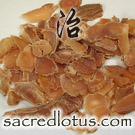 Ren Shen9 gTonify Qi
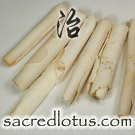 Fu Ling9 gRegulate Water and Drain Dampness
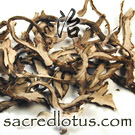 Shi Chang Pu6 gAromatic Substances that Open the Orifices
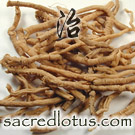 Yuan Zhi6 gNourish the Heart and Calm the Spirit
Preparation & dosage
How is Ding Zhi Wan prepared?
Classically the four herbs are ground to a fine powder and formed into honey pills (wan), taken with warm water or rice wine; the same herbs can also be prepared as a coarse powder or a modern water decoction. Fu Shen (the pine-root-encased sclerotium) may substitute for plain Fu Ling for a slightly stronger spirit-calming effect, and Yuan Zhi is usually honey-fried (zhi Yuan Zhi) beforehand to soften its acrid, GI-irritating quality.
Source: classical pill (wan) preparation per Sun Simiao’s Bei Ji Qian Jin Yao Fang, cross-checked against modern granule/decoction notes from multiple online sources.
Reference relative amounts (as pills or decoction): Ren Shen 9 g; Fu Ling (or Fu Shen) 9 g; Shi Chang Pu 6 g; Yuan Zhi (honey-fried) 6 g. As granules, commonly dosed around 2–4 g, 2–3 times daily, best away from food. As a decoction, standard water-decoction of the same relative amounts, once or twice daily. Reference only; not a prescription.
Safety — read before use
What are the cautions for Ding Zhi Wan?
Ding Zhi Wan is a warming, tonifying formula for deficiency, so it is unsuitable for heat, fire, or pure-excess patterns. Because it tonifies qi and opens the orifices rather than clearing heat, pushing it into a heat-type presentation can aggravate the very agitation it is meant to settle.
- Avoid or modify for yin deficiency with vigorous fire (night sweats, malar flush, red tongue with little coat) — the formula’s tonics can worsen heat signs.
- Not appropriate for Phlegm-Fire or Liver-Fire agitation (irritability, flushed face, bitter taste, rapid pulse) — those patterns call for heat-clearing formulas, not qi tonics.
- Yuan Zhi contains saponins that can irritate the stomach; use cautiously (or avoid) with active gastritis or peptic ulcer disease. Honey-fried (zhi) Yuan Zhi is traditionally used to moderate this.
- Ren Shen is classically incompatible with Li Lu (Veratrum nigrum), one of the "eighteen incompatible medicinals," and should be used cautiously in acute excess-heat conditions.
- Pregnancy, nursing, and diagnosed anxiety or psychiatric conditions: use only under a qualified practitioner alongside appropriate care — not a substitute for medical or psychiatric treatment.
Source: multiple online sources, cross-checked against standard Materia Medica cautions for Yuan Zhi and Ren Shen (Bensky & Barolet). Traditional-use framing; not medical advice.
Originally Appeared In:
- Thousand Ducat Formulas (Qian Jin Yao Fang)
Notes:
How is Ding Zhi Wan different from An Shen Ding Zhi Wan, Suan Zao Ren Tang, and Gui Pi Tang?
Ding Zhi Wan is the base four-herb formula; several well-known formulas expand or diverge from it for related but distinct presentations.
- vs An Shen Ding Zhi Wan: this expanded derivative adds Long Chi (Dens Draconis, sometimes with Fu Shen and a cinnabar coating) to anchor the Shen more forcefully. Favor the expanded version when fright, startle, and palpitations dominate; favor base Ding Zhi Wan when forgetfulness and mental fog from phlegm are more prominent. Note: the two names are easy to conflate in secondary sources — they are related but not interchangeable formulas.
- vs Suan Zao Ren Tang: Suan Zao Ren Tang nourishes Liver blood and clears deficient heat for a restless, "wired" insomnia; Ding Zhi Wan tonifies Heart qi and opens the orifices for insomnia with timidity and mental fog — a different root (blood/yin heat vs. qi/phlegm).
- vs Gui Pi Tang: Gui Pi Tang tonifies Heart and Spleen qi and blood together, and is preferred when digestive weakness (poor appetite, loose stool, fatigue) accompanies the Heart pattern; Ding Zhi Wan is a narrower, orifice-opening formula for qi deficiency with phlegm rather than qi-and-blood deficiency.
Common modifications: add Long Gu and Mu Li (or Long Chi) for more pronounced fright and palpitations; add Suan Zao Ren and Bai Zi Ren when blood-deficiency insomnia is prominent; Dang Shen may substitute for Ren Shen for a gentler, lower-cost version.
Source: comparative notes cross-referenced against multiple online sources; standard formula-differentiation logic per Bensky & Barolet.
Clinical Studies & Research:
Is there modern research on Ding Zhi Wan?
Yes, though it is largely preclinical. Tracked in the literature under its formal name Ding-Zhi-Xiao-Wan (DZXW), the formula has a substantial body of animal and computational research on cognition and mood, but direct clinical-trial evidence in humans remains limited.
- Depression (meta-analysis + network pharmacology): a combined meta-analysis, network-pharmacology, and molecular-docking study found antidepressant-like effects with mechanisms implicating cholinergic and neuroactive ligand-receptor signaling (PMID 37073664).
- Depression mechanism (chronic mild stress, rats): DZXW restored 5-HT (serotonin) synthesis and transport deficits in a chronic-mild-stress depression model (PMID 24184266).
- Memory and learning (scopolamine-induced impairment, mice): DZXW improved spatial-memory (place-navigation) performance and normalized brain glutamate, serotonin, dopamine, and acetylcholine levels (PMID 23397732).
- Alzheimer’s disease (mouse model): DZXW reduced amyloid-beta plaque burden, microglial activation, and oxidative stress markers while improving cognitive performance (PMID 41825647).
Sources: PubMed 37073664; PubMed 24184266; PubMed 23397732; PubMed 41825647. Research context, not a therapeutic claim; evidence is predominantly preclinical/computational, not direct human clinical trials.
Sources & References
Compiled and edited by Thomas Dehli, Founder & Editor, Sacred Lotus Updated
The information here is referenced from numerous sources — teachers, practitioners, class notes from Five Branches University, the books below, and the published research literature, with citations given as resolvable PubMed identifiers. Where sources disagree, I have flagged the discrepancies directly. If facts couldn't be verified, I have left them out. How we source our content.
Reference information for students and practitioners — not medical advice. Consult a qualified practitioner. Terms of use.
Chinese Formulas Books & References
 https://amzn.to/4fYI3f8
 https://amzn.to/4j55NRA
 https://amzn.to/4gMROyv
 https://amzn.to/4h7msSK