

Zhi Jing San (Stop Spasms Powder)
Actions
What does Zhi Jing San do?
Zhi Jing San (Stop Spasms Powder) extinguishes internal wind and stops spasm, unblocking the channels and collaterals to relieve tremor, rigidity, and pain. It is a minimalist prescription of exactly two toxic animal medicinals, Quan Xie (Scorpion) and Wu Gong (Centipede), combined in equal amount and ground to a fine powder rather than decocted.
This site’s own record does not flag chief/deputy/assistant roles for this formula (only two ingredients, equal quantity). Per Bensky & Barolet, the pair functions as mutually reinforcing chiefs rather than a graded hierarchy:
- Quan Xie (Scorpion, Buthus martensii): salty, pungent, neutral, toxic; enters the Liver channel. Traditionally described as moving within the channels to address one-sided spasm, tremor, and facial deviation.
- Wu Gong (Centipede, Scolopendra subspinipes): pungent, warm, toxic; enters the Liver channel. Traditionally regarded as the strongest wind-extinguishing, spasm-stopping animal medicinal, penetrating deeply into the channels and collaterals to relieve pain.
- Together: both amplify the other’s wind-extinguishing, anticonvulsive, and pain-relieving action — the best-known insect/arthropod pair for this purpose in Chinese medicine.
Source: this site’s own composition record/properties + Bensky & Barolet, Formulas & Strategies (2nd ed., p. 401, per multiple online sources). Traditional-use framing; not medical advice.
Indications
What is Zhi Jing San used for?
Zhi Jing San addresses internal (Liver) wind stirring, presenting as spasm, convulsion, or rigidity of the limbs or whole body. As a two-herb “core” prescription in this site’s own category “Formulas that Release Wind from the Skin and Channels,” it is traditionally used alone for milder presentations or, more often, combined into larger formulas for severe or chronic wind-stirring conditions.
Traditional/clinical applications reported across formula references:
- Core presentation: muscle twitching of the extremities; rigidity and spasm of the whole body to the point of opisthotonos (arched-back rigidity); trismus (lockjaw); convulsions; loss of consciousness in severe cases.
- Historically applied to: epidemic (type B) encephalitis, meningitis, tetanus, pediatric convulsions/epilepsy, migraine and cluster headache, and wind-cold painful obstruction.
Tongue and pulse: not recorded in this site’s own record for this formula, and not consistently corroborated across the secondary sources checked — omitted here rather than asserted (see methodology §2).
Source: this site’s own category record + Bensky & Barolet, Formulas & Strategies (p. 401, per multiple online sources) + multiple online sources (cross-checked). Traditional-use framing; not medical advice.
Western Uses:
What is Zhi Jing San used for in modern practice?
In modern practice, Zhi Jing San’s traditional wind-extinguishing/anti-spasmodic use is referenced against conditions Western medicine recognizes as involving seizure or involuntary muscle spasm — including epilepsy, tetanus, viral (type B) encephalitis and meningitis, migraine and trigeminal neuralgia, and stroke-related facial paralysis or spasticity.
These biomedical correlates are offered strictly as a reference to the formula’s traditional use, not as a claim that it treats any disease. We could not verify a clinical trial of the Zhi Jing San combination itself; modern research instead concentrates on its two individual toxic ingredients, largely at the preclinical stage (see research). Because both ingredients are toxic animal medicinals, any therapeutic use belongs with a qualified, licensed practitioner.
Source: traditional-use correlates summarized from Bensky & Barolet, Formulas & Strategies (p. 401) and multiple online sources (epidemic encephalitis B context); reference only, not a treatment claim.
Ingredients
2 substances in Zhi Jing San — each links to its full herb monograph.
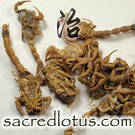 Quan XieEqual QuantityExtinguish Wind and Stop Tremors
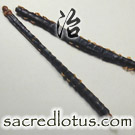 Wu GongEqual QuantityExtinguish Wind and Stop Tremors
Preparation & dosage
How is Zhi Jing San prepared?
True to its name (san = powder), Zhi Jing San is prepared by drying Quan Xie and Wu Gong and grinding them together, in equal parts, into a fine powder rather than decocting them. This entry describes the traditional preparation method as a reference fact; it is not administration or dosing guidance, and any use of either ingredient should be directed by a qualified, licensed practitioner given their toxicity.
Discrepancy: published secondary sources report differing per-dose gram figures for this powder — across multiple online sources, one cites roughly 0.9–1.4 g taken two to four times daily (from a stated 10–20 g bulk preparation range); others cite roughly 0.5–0.75 g of each ingredient; another separately documents a pediatric protocol (for epidemic encephalitis B) citing amounts as low as 0.3 g for a one-year-old. This site’s own record records no formula-level dosage for Zhi Jing San. We report the range of published figures for reference/completeness rather than resolving them into a recommendation.
Source: multiple online sources (formula references, cross-checked, figures vary as noted). Reference only, not administration guidance.
Reference note only, not administration guidance: prepared as a powder (san) from Quan Xie and Wu Gong in equal parts. Published secondary sources report differing figures for the amount taken per dose (see preparation for the discrepancy across multiple online sources); this site’s own record records no formula-level dosage. Both ingredients are toxic (this site’s own record toxic/endangered flag) and contraindicated in pregnancy; any use belongs with a qualified, licensed practitioner.
Safety — read before use
What are the cautions for Zhi Jing San?
Zhi Jing San is built entirely from two toxic animal medicinals — Quan Xie (Scorpion) and Wu Gong (Centipede) — and its use is restricted to professional, practitioner-supervised contexts. The facts below are public-safety reference information, not administration or dosing guidance.
- Both ingredients are formally toxic: this site’s own record flags both Quan Xie and Wu Gong toxic/endangered; secondary references concur (Quan Xie: salty/pungent/neutral/toxic; Wu Gong: pungent/warm/toxic).
- Contraindicated in pregnancy — consistent across the formula references checked multiple online sources.
- Documented toxic effects of Scorpio (Quan Xie) at high exposure include neurotoxicity, elevated liver enzymes (ALT/AST), and cardiovascular/autonomic effects; a 2025 pharmacology/toxicology review notes that quantitative toxicity thresholds (e.g. LD50) for most isolated scorpion-venom components remain unestablished (PMID 41357859).
- Not for large-dose or long-term use per the formula references reviewed; this reflects the general toxicity profile of both ingredients rather than a specific administration recommendation.
Source: this site’s own record toxic/endangered flags + Frontiers in Pharmacology review of Buthus martensii toxicology, PMID 41357859 + caution notes cross-referenced against multiple online sources. Public-safety reference facts only; not medical or dosing advice — consult a qualified, licensed practitioner.
Originally Appeared In:
- Traditional Chinese Medical Formulas (Fang Ji Xue)
Notes:
How is Zhi Jing San modified, and how does it relate to other wind-extinguishing formulas?
Zhi Jing San is deliberately minimal — just the reinforcing Quan Xie/Wu Gong pair — so in practice it is frequently expanded with other herbs to match the underlying cause of the wind-stirring. Reported modifications:
- For tetanus-related muscle twitching: add Fang Feng, Qiang Huo, Bai Zhi, Tian Ma, Tian Nan Xing, and Bai Fu Zi (yielding a formula close to Yu Zhen San).
- For chronic childhood convulsions from Spleen deficiency with prolonged diarrhea: add Gan Jiang, Ren Shen, Bai Zhu, Zhi Gan Cao, and Fu Zi (combining with the Li Zhong Wan strategy of warming and tonifying the Spleen).
- For acute febrile disease with heat stirring wind: add Sang Ye, Ju Hua, Long Dan Cao, Tian Ma, and Gou Teng to clear heat while extinguishing wind.
Within this site’s own record, Zhi Jing San sits in the “Formulas that Release Wind from the Skin and Channels” subcategory alongside other internal/channel wind formulas — comparison to specific formulas in that group (e.g. Qian Zheng San) was not independently verified against a primary source and is omitted here rather than guessed.
Source: Bensky & Barolet, Formulas & Strategies (p. 401, modifications per multiple online sources) + this site’s own category record.
Clinical Studies & Research:
Is there modern research on Zhi Jing San?
Direct clinical research on the Zhi Jing San combination itself was not located in the literature we could verify; modern research instead concentrates on its two toxic ingredients individually, mostly at the preclinical stage.
- Wu Gong (Scolopendra subspinipes): a 2025 scoping review of 45 studies found analgesic, anti-inflammatory, antimicrobial, antioxidant, antitumor, anticoagulant, and neuroprotective bioactivity from venom- and whole-body-derived peptides and alkaloids, but states evidence “remains primarily preclinical” with standardized formulations and human trials still lacking (PMID 40423312).
- Quan Xie (Buthus martensii): a 2025 review documents historical (Song-dynasty) use for stroke, hemiplegia, facial deviation, and spasm/convulsion, correlating with modern anticoagulant, antithrombotic, anti-epileptic, and anticonvulsant pharmacological activity; the same review documents toxic effects at high exposure (neurotoxicity, liver injury, cardiovascular/autonomic effects) and notes LD50 data for isolated venom components is largely unestablished (PMID 41357859).
- Combined scorpion + centipede TCM formulation (not Zhi Jing San specifically): network pharmacology and molecular docking on a scorpion-and-centipede formulation for asthma identified shared targets (including TP53, HSP90AA1) and an IL-17-linked pathway, with effects partially validated in a mouse model — illustrating how this animal-medicinal pair is being studied computationally, not a trial of Zhi Jing San itself (PMID 40605076).
Sources: PubMed 40423312; PubMed 41357859; PubMed 40605076. Preclinical/mechanistic evidence on the individual ingredients and a related two-ingredient formulation; no formula-specific clinical trial evidence located — research context only, not a therapeutic claim.
Sources & References
Compiled and edited by Thomas Dehli, Founder & Editor, Sacred Lotus Updated
The information here is referenced from numerous sources — teachers, practitioners, class notes from Five Branches University, the books below, and the published research literature, with citations given as resolvable PubMed identifiers. Where sources disagree, I have flagged the discrepancies directly. If facts couldn't be verified, I have left them out. How we source our content.
Reference information for students and practitioners — not medical advice. Consult a qualified practitioner. Terms of use.
Chinese Formulas Books & References
 https://amzn.to/4fYI3f8
 https://amzn.to/4j55NRA
 https://amzn.to/4gMROyv
 https://amzn.to/4h7msSK