

Zhu Sha An Shen Wan (Cinnabar Pill to Calm the Spirit)
Zhu Sha An Shen Wan
Cinnabar Pill to Calm the Spirit
- Category
- Formulas that Calm the Spirit
- Subcategory
- Formulas that Sedate and Calm the Spirit
- Ingredients
- 5 herbs
Actions
What does Zhu Sha An Shen Wan do?
Zhu Sha An Shen Wan clears Heart fire and calms/anchors the spirit (shen), while nourishing the blood and yin that prolonged fire has consumed — its name-giving chief ingredient, Zhu Sha (cinnabar), is a heavy mineral traditionally used specifically to settle spirit disturbance caused by fire harassing the Heart.
- Clears Heart fire: Huang Lian, at the formula's largest dose, powerfully drains fire at its source.
- Anchors and calms the spirit: Zhu Sha settles shen disturbance, addressing insomnia, palpitations, and restlessness.
- Nourishes blood and yin: Dang Gui and Sheng Di Huang replenish the blood and yin that sustained Heart fire has damaged, addressing the root as well as the branch.
- Harmonizes: Zhi Gan Cao moderates the bitterness of Huang Lian and the mineral nature of Zhu Sha.
Source: Sacred Lotus sources & references (composition) + Bensky & Barolet, Formulas & Strategies; Chen & Chen, Chinese Medical Herbology and Pharmacology. Traditional-use framing; not medical advice.
Indications
What is Zhu Sha An Shen Wan used for?
Zhu Sha An Shen Wan treats Heart fire harassing the spirit against a backdrop of blood and yin deficiency — a pattern in which fire has been present long enough to also deplete the blood and yin that should anchor the Heart, producing agitated rather than purely deficient sleep disturbance.
- Insomnia, especially difficulty staying asleep or unsettled, restless sleep
- Palpitations and a sense of inner agitation or unease
- Vivid or disturbing dreams
- Irritability and mental restlessness
- Mouth or tongue sores, or a sensation of heat rising to the chest and face (Heart fire flaring upward)
- A red tongue and a thin, rapid pulse, reflecting fire together with underlying deficiency
Source: Sacred Lotus sources & references (pattern/tongue/pulse fields) + Bensky & Barolet, Formulas & Strategies. Traditional-use framing; not medical advice.
Ingredients
5 substances in Zhu Sha An Shen Wan — each links to its full herb monograph.
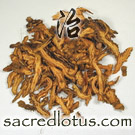 Huang Lian18 gClear Heat and Dry Dampness
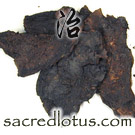 Sheng Di Huang7.5 gCool the Blood
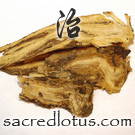 Dang Gui7.5 gTonify Blood
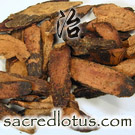 Zhi Gan Cao16.5 gTonify Qi
Preparation & dosage
How is Zhu Sha An Shen Wan prepared?
Zhu Sha An Shen Wan is a pill (wan), and its classical construction is distinctive: Sacred Lotus's composition record notes Zhu Sha as "refined with water" (shui fei) — a traditional water-levigation technique that grinds the mineral under water to a very fine, more uniform powder. Classical formularies describe the remaining four herbs (Huang Lian, Dang Gui, Sheng Di Huang, Zhi Gan Cao) being ground and formed into a pill core with wine or water, which is then coated (yi) in the levigated cinnabar powder as an outer "clothing" rather than blended uniformly throughout the pill mass.
- Rationale for coating rather than blending: applying cinnabar as a surface coat concentrates it where it can act most directly (traditionally, on contact) while limiting the total mineral content mixed into the pill's interior.
- Administration: taken as a small pill, traditionally in modest quantity given the mineral content.
Source: Bensky & Barolet, Formulas & Strategies (classical pill construction, cinnabar-as-coating convention); Sacred Lotus sources & references (processing note, "refined with water").
Safety — read before use
What are the cautions for Zhu Sha An Shen Wan?
Zhu Sha An Shen Wan's chief and name-giving ingredient is Zhu Sha (cinnabar, mercury sulfide, HgS) — this section documents mercury's toxicity, its regulatory status, and modern substitution practice as neutral public-safety reference, not administration guidance.
- Mercury toxicity: modern toxicology studies of cinnabar and of Zhu Sha An Shen Wan specifically have documented hepatotoxic and nephrotoxic effects, including altered renal transporter gene expression and metabolic changes comparable to other mercury compounds (mercuric chloride, methylmercury) in animal models.
- Regulatory restriction: cinnabar-containing preparations are subject to import restriction in a number of jurisdictions (including FDA import alerts in the United States) and are tightly controlled or restricted for internal use in China, reflecting accumulated toxicological evidence.
- Modern substitution: reflecting this evidence, contemporary clinical formularies and much current commercial manufacture replace or omit Zhu Sha, commonly substituting non-mercury calming/anchoring minerals such as Long Gu, Mu Li, or Ci Shi (Magnetite) for the spirit-anchoring action, or reformulating the pill without a mineral component — noted here as a documented practice pattern, not a recommendation.
- General: traditionally contraindicated in pregnancy and in patients with hepatic or renal impairment; not intended for prolonged or unsupervised use.
Source: PMID 23376283 (metabolic profiling of hepatotoxicity/nephrotoxicity); PMID 21126564 (nephrotoxicity of mercuric chloride, methylmercury, and cinnabar-containing Zhu-Sha-An-Shen-Wan); PMID 26084178 (renal transporter gene expression); PMID 28864167 (review of cinnabar/realgar-containing traditional medicines); PMID 40393107 (2025 safety assessment of cinnabar). Neutral public-safety reference; not administration guidance.
Originally Appeared In:
- Clarifying Doubts About Injury from Internal and External Causes (Nei Wai Shang Bian Huo Lun)
Notes:
How does Zhu Sha An Shen Wan differ from Tian Wang Bu Xin Dan and Huang Lian E Jiao Tang?
Zhu Sha An Shen Wan is distinguished among Heart-calming formulas by its mineral chief ingredient and its emphasis on fire clearing over pure yin nourishment.
- vs Tian Wang Bu Xin Dan (Emperor of Heaven's Special Pill to Tonify the Heart): a broader yin-and-blood-nourishing formula for chronic Heart/Kidney yin deficiency with mild heat, containing no mineral ingredient; used when deficiency predominates and fire is comparatively mild.
- vs Huang Lian E Jiao Tang (Coptis and Ass-Hide Gelatin Decoction): from the Shang Han Lun, treats a deeper yin-deficiency-fire pattern disturbing sleep, built around Ejiao's rich yin/blood nourishment rather than a mineral anchor; chosen when yin deficiency is more central and an anchoring mineral is not indicated.
Classical source and modern substitution: Zhu Sha An Shen Wan is commonly attributed to Li Dongyuan (Li Gao), a leading physician of the Jin-Yuan period (13th century), in formularies tracing it to his writings on internal damage. Given cinnabar's documented mercury toxicity (see cautions), it is worth noting that Sacred Lotus's composition record retains the classical Zhu Sha ingredient as originally described, whereas most modern commercial and clinical versions substitute a non-mercury mineral or omit the mineral component — a discrepancy between classical and contemporary practice, not an error in the underlying data.
Source: Bensky & Barolet, Formulas & Strategies (classical attribution, formula comparisons, modern substitution practice).
Clinical Studies & Research:
Is there modern research on Zhu Sha An Shen Wan?
Yes, but nearly all of it is toxicology and safety research on the cinnabar (mercury) content, rather than efficacy research — reflecting the modern research community's focus on this formula as a case study in traditional-mineral-medicine safety.
- Comparative nephrotoxicity: a study compared the nephrotoxicity of mercuric chloride, methylmercury, and cinnabar-containing Zhu-Sha-An-Shen-Wan in rats (PMID 21126564).
- Metabolic profiling: a metabolomics study analyzed acute hepatotoxicity and nephrotoxicity of Zhu Sha An Shen Wan compared with cinnabar alone (PMID 23376283).
- Mechanism (renal transporters): a study examined gene expression of renal transporters related to cinnabar and mercury compounds (PMID 26084178).
- Broader cinnabar review and recent safety work: a review of cinnabar- and realgar-containing traditional medicines (PMID 28864167) and a 2025 study assessing whether co-administered selenium can mitigate cinnabar's renal toxicity in mice (PMID 40393107).
Sources: PMID 21126564; PMID 23376283; PMID 26084178; PMID 28864167; PMID 40393107. Research context only — toxicology/safety research, not evidence of therapeutic efficacy.
Sources & References
Compiled and edited by Thomas Dehli, Founder & Editor, Sacred Lotus Updated
The information here is referenced from numerous sources — teachers, practitioners, class notes from Five Branches University, the books below, and the published research literature, with citations given as resolvable PubMed identifiers. Where sources disagree, I have flagged the discrepancies directly. If facts couldn't be verified, I have left them out. How we source our content.
Reference information for students and practitioners — not medical advice. Consult a qualified practitioner. Terms of use.
Chinese Formulas Books & References
 https://amzn.to/4fYI3f8
 https://amzn.to/4j55NRA
 https://amzn.to/4gMROyv
 https://amzn.to/4h7msSK