

Jian Pi Wan (Strengthen the Spleen Pill)
Jian Pi Wan
Strengthen the Spleen Pill
- Category
- Formulas that Reduce Food Stagnation
- Subcategory
- Formulas that Reduce Food Stagnation
- Ingredients
- 13 herbs
Actions
What does Jian Pi Wan do?
Jian Pi Wan (Strengthen the Spleen Pill) tonifies Spleen and Stomach qi while simultaneously clearing food stagnation and stopping diarrhea. It is built on the classic qi-tonic base Si Jun Zi Tang (Ren Shen, Bai Zhu, Fu Ling, Gan Cao), then layered with digestive and astringent herbs so a weakened digestion can both rebuild itself and clear the undigested food sitting in it — two problems that, left untreated, keep reinforcing each other.
The thirteen ingredients divide by role:
- Chief: Ren Shen and Bai Zhu tonify Spleen and Stomach qi — the foundational pair that addresses the underlying deficiency.
- Deputies: Fu Ling and Shan Yao strengthen the Spleen and support digestion; Shan Zha, Shen Qu, and Mai Ya are the classic trio for reducing food stagnation (each is traditionally associated with a different class of retained food — meat/fatty food, fermented grain, and starches, respectively); Rou Dou Kou warms and astringes the intestines to check chronic loose stools.
- Assistants: Mu Xiang, Sha Ren, and Chen Pi are aromatic qi-movers that transform dampness and keep the tonifying herbs from becoming stagnant or cloying; Huang Lian is used in a small, wine-fried dose to clear the mild heat that retained food and dampness tend to generate, and to temper the warm, drying herbs around it.
- Envoy: Gan Cao harmonizes the formula and supports Spleen qi.
Source: Sacred Lotus sources & references + Bensky & Barolet, Formulas & Strategies (chief/deputy/assistant/envoy analysis). Traditional-use framing; not medical advice.
Indications
What is Jian Pi Wan used for?
Jian Pi Wan treats Spleen and Stomach qi deficiency complicated by food stagnation and damp — a pattern where the digestion is too weak to fully process food, so it accumulates and generates further fullness and looseness, on top of the underlying fatigue and poor appetite.
Its classic clinical presentation:
- Deficiency signs: poor appetite, fatigue and lack of strength, sallow complexion, a tendency toward loose or chronic diarrhea.
- Food-stagnation/damp signs: epigastric and abdominal distention or fullness (often worse after eating), belching or a sour taste, stools that may contain undigested food.
- Presentation in children: traditionally applied to poor appetite, slow growth, and loose stools associated with weak digestion.
Tongue and pulse: a slightly yellow, greasy tongue coating; a deficient, frail pulse.
Source: Sacred Lotus sources & references on pattern/tongue/pulse + Bensky & Barolet, Formulas & Strategies. Traditional-use framing; not medical advice.
Western Uses:
What is Jian Pi Wan used for in modern practice?
In modern practice Jian Pi Wan is referenced for chronic digestive weakness with poor appetite and loose stools — practitioners have traditionally applied its qi-tonifying, digestion-supporting pattern to presentations resembling chronic gastritis, functional dyspepsia, chronic or functional diarrhea, and slow digestive recovery in children, contexts where Western medicine recognizes reduced appetite and disordered bowel function.
These biomedical correlates are offered as a reference to the formula’s traditional use, not as a claim that it treats any diagnosed disease. Direct clinical-trial evidence on this specific classical formula remains sparse in PubMed-indexed literature (see research). Any use for a diagnosed digestive condition belongs with a qualified practitioner and appropriate medical care.
Source: traditional-use correlates summarized from Bensky & Barolet, Formulas & Strategies; reference only, not a treatment claim.
Ingredients
13 substances in Jian Pi Wan — each links to its full herb monograph.
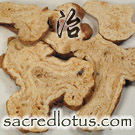 Bai Zhu75 gdry friedTonify Qi
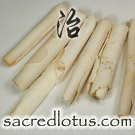 Fu Ling60 gRegulate Water and Drain Dampness
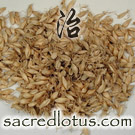 Mai Ya30 gdry friedRelieve Food Stagnation
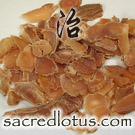 Ren Shen45 gTonify Qi
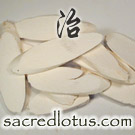 Shan Yao30 gTonify Qi
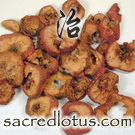 Shan Zha30 gRelieve Food Stagnation
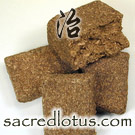 Shen Qu30 gdry friedRelieve Food Stagnation
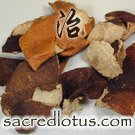 Chen Pi30 gRegulate the Qi
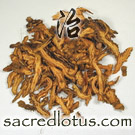 Huang Lian22.5 gwine friedClear Heat and Dry Dampness
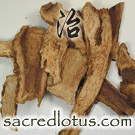 Mu Xiang22.5 gRegulate the Qi
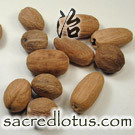 Rou Dou Kou30 gAstringe, Stabilize, Bind
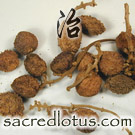 Sha Ren30 gAromatic Herbs that Transform and Dissolve Dampness
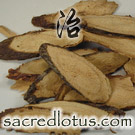 Gan Cao22.5 gTonify Qi
Preparation & dosage
How is Jian Pi Wan prepared?
Traditionally the herbs are ground to a fine powder and formed into pills (wan) with water — hence the name “Strengthen the Spleen Pill.” It can also be prepared as a decoction (tang) using proportionally reduced amounts of the same herbs, which is common in modern clinical use so the formula can be modified herb-by-herb for the individual case.
Source: Bensky & Barolet, Formulas & Strategies (preparation conventions for classical pill formulas). Traditional-use framing; not medical advice.
Traditionally taken as a pill (wan), ~6-9 g twice daily with warm water. Reference relative amounts if prepared as a decoction: Bai Zhu 75 g (dry-fried); Fu Ling 60 g; Ren Shen 45 g; Shan Yao, Rou Dou Kou (roasted), Shan Zha, Shen Qu (dry-fried), Mai Ya (dry-fried), Chen Pi, Sha Ren 30 g each; Mu Xiang, Huang Lian (wine-fried), Gan Cao 22.5 g each. Dang Shen (roughly 2-3x the amount) commonly substitutes for Ren Shen. Reference only; not a prescription.
Safety — read before use
What are the cautions for Jian Pi Wan?
Jian Pi Wan is written for deficiency underlying the stagnation, so it is not appropriate for acute, purely excess food stagnation (e.g. overeating or spoiled food in an otherwise strong digestion) — a purely dispersing formula such as Bao He Wan fits that picture better. Its astringent herb, Rou Dou Kou, is also traditionally avoided in damp-heat diarrhea or dysentery with tenesmus, where astringing can trap the pathogenic factor.
- Avoid or modify in acute excess food stagnation without underlying Spleen/Stomach deficiency.
- Avoid the astringent action in damp-heat dysentery/tenesmus — astringing herbs like Rou Dou Kou can worsen retention of the pathogen.
- Pregnancy: contains Huang Lian (cold) and aromatic qi-movers (Mu Xiang, Sha Ren) — use only under professional guidance.
Source: Bensky & Barolet, Formulas & Strategies (cautions for food-stagnation and astringent formulas). Traditional-use framing; not medical advice.
Originally Appeared In:
- Standards of Patterns and Treatments (Zheng Zhi Zhun Sheng)
Notes:
How is Jian Pi Wan different from Si Jun Zi Tang and Bao He Wan?
Jian Pi Wan is Si Jun Zi Tang (the basic qi tonic) expanded with digestive and astringent herbs for deficiency complicated by food stagnation — it sits between a pure tonic and a pure dispersing formula.
- vs Si Jun Zi Tang: add the food-stagnation and astringent herbs (Shan Zha, Shen Qu, Mai Ya, Rou Dou Kou, Huang Lian, Mu Xiang, Sha Ren, Chen Pi, Shan Yao) when poor appetite and fatigue are accompanied by distention, undigested food, and loose stools.
- vs Bao He Wan: Bao He Wan disperses food stagnation for an excess pattern (e.g. acute overeating) with no underlying deficiency and no tonics; Jian Pi Wan is chosen when a weak Spleen and Stomach is the root cause of the stagnation.
Reported modifications: add Gan Jiang and Zhi Ban Xia for nausea/vomiting; add Yi Yi Ren, Che Qian Zi, and Ze Xie for pronounced dampness; combine with Fu Zi Li Zhong Wan and add Ding Xiang for early-morning ("five-more") diarrhea from Spleen-Kidney yang deficiency; for pediatric malnutrition/poor growth, remove Gan Cao and add Zhi Shi and Bing Lang. Dang Shen (at roughly 2-3x the amount) commonly substitutes for Ren Shen.
Source: Sacred Lotus sources & references + Bensky & Barolet, Formulas & Strategies; reported modifications cross-checked against published formula references. Traditional-use framing; not medical advice.
Clinical Studies & Research:
Is there modern research on Jian Pi Wan?
Direct clinical-trial or mechanistic research specific to this classical 13-herb formula is sparse in PubMed-indexed literature — most published "Jianpi" (spleen-strengthening) research concerns other, differently-composed formulas that share the generic term (e.g. Jianpi Yiqi, Jianpi Liqi, Jianpi Qingchang), which are not this formula and are not cited here.
One relevant caution from the modern literature concerns product-name confusion:
- Commercial product authenticity (not this formula): a 2025 DNA-metabarcoding study of 56 commercial samples of "Renshen Jianpi Wan" — a related but differently composed patent formula (adds Huang Qi, Dang Gui, Suan Zao Ren, Yuan Zhi; omits Huang Lian and Rou Dou Kou) — found inconsistent detection of prescribed ingredients (Poria cocos was undetectable in tested samples) and frequent non-prescribed contaminant species, i.e. a quality-control/adulteration concern for that commercial product line, not efficacy evidence for the classical formula described here (PMID 40356966).
Sources: PubMed search conducted for this formula's exact composition (no matching indexed clinical trials found); PubMed 40356966 (product-authenticity study of a related, differently-composed patent formula, cited only as a discrepancy/product-naming caution). Research context, not a therapeutic claim.
Sources & References
Compiled and edited by Thomas Dehli, Founder & Editor, Sacred Lotus Updated
The information here is referenced from numerous sources — teachers, practitioners, class notes from Five Branches University, the books below, and the published research literature, with citations given as resolvable PubMed identifiers. Where sources disagree, I have flagged the discrepancies directly. If facts couldn't be verified, I have left them out. How we source our content.
Reference information for students and practitioners — not medical advice. Consult a qualified practitioner. Terms of use.
Chinese Formulas Books & References
 https://amzn.to/4fYI3f8
 https://amzn.to/4j55NRA
 https://amzn.to/4gMROyv
 https://amzn.to/4h7msSK