

Qing Qi Hua Tan Wan (Clear the Qi and Transform Phlegm Pill)
Qing Qi Hua Tan Wan
Clear the Qi and Transform Phlegm Pill
- Category
- Formulas that Treat Phlegm
- Subcategory
- Formulas that Clear Heat and Transform Phlegm
- Ingredients
- 8 herbs
Actions
What does Qing Qi Hua Tan Wan do?
Qing Qi Hua Tan Wan clears heat, transforms phlegm-heat, and directs rebellious Lung qi downward to stop cough. It is built from eight herbs and is best understood as a heat-clearing reworking of the foundational phlegm-damp formula Er Chen Tang: the base pairing of Ban Xia and Chen Pi is kept, Zhi Gan Cao is dropped, and Dan Nan Xing, Gua Lou Ren, Huang Qin, Xing Ren, and Zhi Shi are added to shift the formula from a warm, damp-phlegm profile to a cool, phlegm-heat profile.
The eight ingredients divide by role:
- Chief: Dan Nan Xing (bile-processed Arisaema) clears heat and transforms stubborn phlegm; Gua Lou Ren (Trichosanthes Seed) clears heat, moistens, transforms phlegm, and opens the chest — together they address both the heat and the phlegm at the core of the pattern.
- Deputies: Huang Qin clears heat from the Lung and upper burner; Zhi Shi breaks up qi stagnation, directs rebellious qi downward, and disperses phlegm accumulating in the chest and epigastrium.
- Assistants: Ban Xia and Chen Pi dry dampness and transform phlegm (the classic Er Chen Tang pairing, moderating the formula's coolness); Xing Ren directs Lung qi downward, moistens, and stops cough; Fu Ling strengthens the Spleen and drains dampness, addressing the Spleen as the source of phlegm production while the Lung is only its "receptacle."
- Preparation role: in the traditional pill form the herbs are bound with fresh ginger juice, which helps harmonize the Stomach and offsets the formula's cooling, bitter herbs.
Source: Sacred Lotus sources & references/dosages + Bensky & Barolet, Formulas & Strategies (chief/deputy/assistant analysis; relationship to Er Chen Tang). Traditional-use framing; not medical advice.
Indications
What is Qing Qi Hua Tan Wan used for?
Qing Qi Hua Tan Wan treats Phlegm-Heat obstructing the Lung — a pattern in which heat cooks Lung fluids into thick, sticky phlegm that blocks the Lung's normal downward-directing function, producing a heavy, productive cough.
Its classic clinical presentation:
- Cough with copious, thick, sticky sputum that is yellow (or yellow-green) and difficult to expectorate.
- Fullness or oppression in the chest and diaphragm, sometimes with labored or rapid breathing.
- Severe coughing fits that can be forceful enough to trigger vomiting, plus a dry mouth or throat from the accompanying heat.
Tongue and pulse: traditionally described as a red tongue with a yellow, greasy coating, and a slippery, rapid pulse — signs of heat combined with phlegm accumulation.
Source: Bensky & Barolet, Formulas & Strategies (indications, tongue, pulse) + Sacred Lotus sources & references for the underlying herb pattern. Traditional-use framing; not medical advice.
Western Uses:
What is Qing Qi Hua Tan Wan used for in modern practice?
In modern practice Qing Qi Hua Tan Wan is referenced for the traditional phlegm-heat cough pattern — a heavy, productive cough with thick yellow sputum and chest fullness. Practitioners have traditionally applied this pattern to presentations resembling acute or chronic bronchitis, and as adjunctive support during exacerbations of chronic obstructive pulmonary disease, in contexts where Western medicine recognizes excess mucus production and airway inflammation.
These biomedical correlates are offered as a reference to the formula’s traditional use, not as a claim that it treats any disease. Modern study of it is preliminary and mostly mechanistic or in combination with other formulas (see research). Any use for a diagnosed respiratory condition belongs with a qualified practitioner and appropriate medical care.
Source: traditional-use correlates summarized from Bensky & Barolet, Formulas & Strategies; reference only, not a treatment claim.
Ingredients
8 substances in Qing Qi Hua Tan Wan — each links to its full herb monograph.
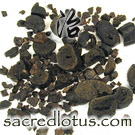 Dan Nan Xing45 gCool and Transform Phlegm-Heat
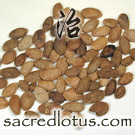 Gua Lou Ren30 gCool and Transform Phlegm-Heat
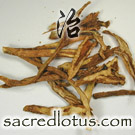 Huang Qin30 gClear Heat and Dry Dampness
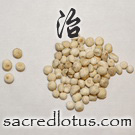 Ban Xia45 gWarm Herbs that Transform Phlegm-Cold
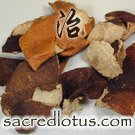 Chen Pi30 gRegulate the Qi
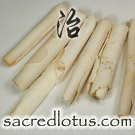 Fu Ling30 gRegulate Water and Drain Dampness
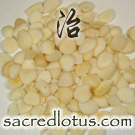 Xing Ren30 gRelieve Coughing and Wheezing
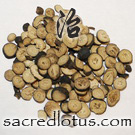 Zhi Shi30 gRegulate the Qi
Preparation & dosage
How is Qing Qi Hua Tan Wan prepared?
Classically the eight herbs are ground to a fine powder and bound into pills with fresh ginger juice (per the formula's original source, Yi Fang Kao), taken with warm water. The formula is also commonly encountered today as a granule or tablet patent medicine (e.g., "Qing Qi Hua Tan Pian") prepared as a concentrated extract of the same eight herbs, and can be decocted as a standard water decoction as well.
Source: Bensky & Barolet, Formulas & Strategies (original source text and preparation).
Traditional pill: herbs ground to powder and formed into pills with fresh ginger juice. Reference relative amounts (raw herb, per Sacred Lotus sources & references): Dan Nan Xing, Ban Xia 45 g each; Gua Lou Ren, Huang Qin, Chen Pi, Xing Ren, Zhi Shi, Fu Ling 30 g each. As a decoction, amounts are typically scaled down proportionally. Modern patent/granule versions are commonly dosed around 6-9 g, twice daily. Reference only.
Safety — read before use
What are the cautions for Qing Qi Hua Tan Wan?
Qing Qi Hua Tan Wan is a cooling, drying, downward-directing formula for a heat-phlegm excess pattern, so it is inappropriate where there is no clear heat sign. Its bitter, cold, and drying herbs can injure Lung or Stomach yin and worsen a dry cough, and can burden a Spleen that is already qi-deficient.
- Avoid in cold-phlegm or damp-cold patterns (thin, white, watery sputum) and in dry cough from Lung- or yin-deficiency without phlegm-heat — the formula's bitter, drying herbs are not a fit and can aggravate dryness.
- Weak digestion / loose stools: Gua Lou Ren has a mildly moistening, laxative quality; use cautiously with a tendency toward loose stools, and Zhi Shi's strong qi-breaking action calls for caution in general qi or Spleen deficiency.
- Pregnancy: contains qi-breaking and downward-directing herbs (Zhi Shi, Xing Ren) — use only under professional guidance.
- Herb interaction: Ban Xia is traditionally listed among the "eighteen antagonisms" (shi ba fan) as incompatible with aconite-type herbs (Chuan Wu, Cao Wu, Fu Zi) and should not be combined with them.
Source: Bensky & Barolet, Formulas & Strategies (cautions for phlegm-heat formulas; traditional herb-incompatibility list). Traditional-use framing; not medical advice.
Originally Appeared In:
- Investigations of Medical Formulas (Yi Fang Kao)
Notes:
How is Qing Qi Hua Tan Wan different from Er Chen Tang, Xiao Xian Xiong Tang, and Bei Mu Gua Lou San?
Qing Qi Hua Tan Wan is Er Chen Tang reworked for heat. It keeps Er Chen Tang's Ban Xia + Chen Pi (+ Fu Ling) core, drops Zhi Gan Cao, and adds Dan Nan Xing, Gua Lou Ren, Huang Qin, Xing Ren, and Zhi Shi — turning a warm damp-phlegm formula into a cool phlegm-heat formula that also directs qi downward and stops cough.
- vs Er Chen Tang: use Er Chen Tang for plain damp-phlegm (white, profuse, easy-to-expectorate sputum, no heat signs); move to Qing Qi Hua Tan Wan once the phlegm turns thick, sticky, and yellow with a red tongue and rapid pulse.
- vs Xiao Xian Xiong Tang (Gua Lou Shi, Huang Lian, Ban Xia): that formula treats phlegm-heat that has bound more tightly in the chest, with focal distension or pain on palpation under the sternum — a more acute, localized "chest bind." Qing Qi Hua Tan Wan is for the more diffuse cough-with-copious-sputum presentation, without the bound, painful chest.
- vs Bei Mu Gua Lou San: that formula addresses drier phlegm-heat with Lung-fluid damage — sputum that is scant, sticky, and hard to expectorate from dryness rather than heat-cooked excess phlegm. It is gentler and omits strongly bitter, drying, or qi-breaking herbs (no Huang Qin, no Zhi Shi), fitting a drier, less excess presentation than Qing Qi Hua Tan Wan.
Discrepancy note: some herb-shop and reference listings file Qing Qi Hua Tan Wan under a general "dries dampness and expels phlegm" grouping (the same grouping as Er Chen Tang). Formula-strategy texts such as Bensky & Barolet instead classify it under formulas that clear heat and transform phlegm, distinct from Er Chen Tang's damp-phlegm category — consistent with its heat-clearing herbs (Dan Nan Xing, Gua Lou Ren, Huang Qin) and heat-pattern indications above. This page follows the heat-transforming classification; the formula's category assignment in the database was not altered by this content pass.
Source: Bensky & Barolet, Formulas & Strategies (formula relationships, classification, comparison formulas).
Clinical Studies & Research:
Is there modern research on Qing Qi Hua Tan Wan?
Yes, but it is limited and mostly mechanistic or studied in combination with other formulas, not as a stand-alone clinical trial. A rat-model study of acute exacerbation of chronic obstructive pulmonary disease (phlegm-heat stagnating in the Lung pattern) found that Zhuye Shigao Decoction combined with Qingqi Huatan Pills reduced IL-6 expression and downregulated JAK1/STAT3 signaling alongside improved airflow and reduced lung inflammation. A separate in-vitro study using human airway epithelial (H292) cells found that Qingqi Huatan Pills, combined with Xiao Qing Long Tang, were associated with inhibition of NF-κB/microRNA-494 signaling linked to mucin (MUC5AC) hypersecretion and with restored CFTR channel expression, proposing a mechanism for reduced pathological airway mucus.
- COPD exacerbation, rat model (combination formula): Zhuye Shigao Decoction + Qingqi Huatan Pills reduced IL-6 and JAK1/STAT3 pathway activity, improving airflow limitation and lung inflammation (PMID 35571736).
- Airway mucus hypersecretion, H292 cell model (combination formula): Xiao Qing Long Tang + Qingqi Huatan Pills linked to NF-κB/miR-494 pathway inhibition and CFTR restoration (PMID 36177926).
Sources: PubMed 35571736; PubMed 36177926. Both studies test Qing Qi Hua Tan Wan in combination with another formula, not alone, and are preclinical (animal/cell) models — research context, not a therapeutic claim; direct clinical trial evidence on this formula alone remains limited/unverified and is omitted here.
Sources & References
Compiled and edited by Thomas Dehli, Founder & Editor, Sacred Lotus Updated
The information here is referenced from numerous sources — teachers, practitioners, class notes from Five Branches University, the books below, and the published research literature, with citations given as resolvable PubMed identifiers. Where sources disagree, I have flagged the discrepancies directly. If facts couldn't be verified, I have left them out. How we source our content.
Reference information for students and practitioners — not medical advice. Consult a qualified practitioner. Terms of use.
Chinese Formulas Books & References
 https://amzn.to/4fYI3f8
 https://amzn.to/4j55NRA
 https://amzn.to/4gMROyv
 https://amzn.to/4h7msSK