

Tu Si Zi Wan (Cuscuta Seed Pill)
Tu Si Zi Wan
Cuscuta Seed Pill
- Category
- Formulas that Tonify
- Subcategory
- Formulas that Warm and Tonify the Yang
- Ingredients
- 11 herbs
Actions
What does Tu Si Zi Wan do?
Tu Si Zi Wan warms Kidney yang, tonifies Kidney qi and essence, and astringes (secures) the essence and urine. It is built around a strong core of yang-warming, essence-building herbs paired with astringent herbs that restore the Kidney's "grasping and holding" function once yang has been rekindled.
The eleven ingredients divide functionally:
- Chief: Tu Si Zi (Cuscuta seed) — the formula's namesake; warms Kidney yang and nourishes Kidney/Liver essence without the dryness of stronger yang tonics, and is itself mildly astringent.
- Supporting yang and essence tonics: Lu Rong (deer antler velvet) powerfully reinforces yang, essence, and marrow; Rou Cong Rong moistens while it warms, tempering dryness; Fu Zi ignites Kidney yang (mingmen fire) to dispel deep interior cold; Shan Yao tonifies Kidney, Spleen, and Lung and itself helps secure essence.
- Astringent, securing assistants: Sang Piao Xiao, Yi Zhi Ren, Wu Wei Zi, and calcined Mu Li each astringe and stabilize — reducing urinary frequency/leakage and preventing seminal emission — while Wu Yao warms the Kidney and Bladder and directs qi downward to aid transformation of urine.
- Envoy: Ji Nei Jin targets frequent urination directly and helps the digestive system process the formula's rich tonics.
Source: Sacred Lotus sources & references + Bensky & Barolet, Formulas & Strategies (Kidney yang-tonifying category methodology; individual herb actions). Traditional-use framing; not medical advice.
Indications
What is Tu Si Zi Wan used for?
Tu Si Zi Wan treats Kidney yang deficiency together with Kidney qi that is "not firm" — that is, yang is too weak to warm the lower body and the Kidney has lost its ability to grasp and contain essence, qi, and fluids. The origin text (Ji Sheng Fang) describes this as Kidney qi deficiency with insufficiency of primal yang.
Its classic clinical presentation:
- Loss-of-containment signs: frequent or copious clear urination, urinary dribbling/incontinence, and seminal emission.
- Yang-deficiency cold signs: a weak, aching, or cold lower back and knees with little strength, general exhaustion, and aversion to cold.
- Reproductive weakness: impotence associated with underlying Kidney yang deficiency.
Pulse: submerged (deep) and thin, reflecting deficiency at the Kidney level.
Source: Sacred Lotus sources & references on pulse + formula origin text, Ji Sheng Fang (Formulas to Aid the Living, Yan Yonghe, 1253 CE) + Bensky & Barolet, Formulas & Strategies. Traditional-use framing; not medical advice.
Western Uses:
What is Tu Si Zi Wan used for in modern practice?
In modern practice Tu Si Zi Wan is referenced for patterns of urinary frequency/incontinence, seminal emission, and lower-back weakness attributed to Kidney yang deficiency. Practitioners have traditionally applied it to presentations such as nocturnal enuresis, overactive-bladder-type frequency, premature ejaculation, and general fatigue with cold intolerance — contexts where Western medicine recognizes reduced bladder control or fatigue-with-cold-sensitivity.
These biomedical correlates are offered as a reference to the formula's traditional use, not as a claim that it treats any diagnosed condition. Direct clinical-trial evidence on the formula itself is very limited (see research). Any use for a diagnosed urinary, reproductive, or endocrine condition belongs with a qualified practitioner and appropriate medical care.
Source: traditional-use correlates summarized from the formula's classical indications (Ji Sheng Fang) and Bensky & Barolet, Formulas & Strategies; reference only, not a treatment claim.
Ingredients
11 substances in Tu Si Zi Wan — each links to its full herb monograph.
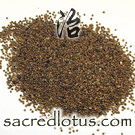 Tu Si Zi60 gTonify Yang
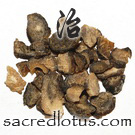 Fu Zi30 gWarm the Interior and Expel ColdNo specimen photographLu Rong30 gTonify Yang
 Rou Cong Rong60 gTonify Yang
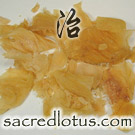 Ji Nei Jin15 gRelieve Food Stagnation
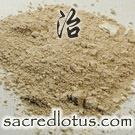 Mu Li60 gCalcinedAnchor, Settle, and Calm the Spirit
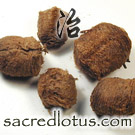 Sang Piao Xiao30 gAstringe, Stabilize, Bind
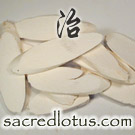 Shan Yao30 gTonify Qi
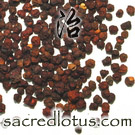 Wu Wei Zi30 gAstringe, Stabilize, Bind
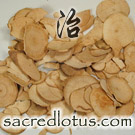 Wu Yao30 gRegulate the Qi
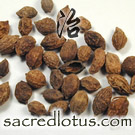 Yi Zhi Ren30 gTonify Yang
Preparation & dosage
How is Tu Si Zi Wan prepared?
Traditionally prepared as pills: the herbs are ground to a fine powder and bound into pills (classically with wine), calcined Mu Li being processed (calcined) before grinding. Modern practice also decocts the formula at proportionally reduced amounts, pre-decocting the calcined Mu Li for 20–30 minutes before adding the remaining herbs.
Source: formula preparation convention for wine-bound pills containing calcined shell minerals, consistent with Bensky & Barolet, Formulas & Strategies. Reference only, not a dosing instruction.
Pills (wan): reference relative amounts per Sacred Lotus sources & references — Tu Si Zi, Rou Cong Rong, Mu Li (calcined) 60 g each; Lu Rong, Shan Yao, Fu Zi, Wu Yao, Wu Wei Zi, Sang Piao Xiao, Yi Zhi Ren 30 g each; Ji Nei Jin 15 g. Classically taken as ground/pilled powder, a few grams per dose, with warm salted water. Reference only; not a prescribing instruction.
Safety — read before use
What are the cautions for Tu Si Zi Wan?
Tu Si Zi Wan is a warming, astringent formula for deficiency-cold, so it is inappropriate wherever there is heat. It should be avoided in Kidney yin deficiency with heat (deficiency-fire) signs and in damp-heat patterns with burning, scanty, dark urine — astringing and warming would trap the pathogen and worsen heat signs. It is likewise unsuitable during an active exterior (cold/flu) invasion.
- Contains Fu Zi (prepared aconite): it must be properly processed (prepared/zhi) and used only under professional guidance.
- Pregnancy: the strongly warming Fu Zi and Rou Cong Rong warrant caution; use only under professional guidance.
- Astringent herbs (Mu Li, Sang Piao Xiao, Wu Wei Zi): avoid where there is unresolved damp, food stagnation, or an active pathogenic invasion, since containing herbs can "lock in" a pathogen.
Source: Bensky & Barolet, Formulas & Strategies (cautions for yang-tonifying and astringent/securing formulas; Fu Zi processing and pregnancy cautions). Traditional-use framing; not medical advice.
Originally Appeared In:
- Formulas to Aid the Living (Ji Sheng Fang)
Notes:
How does Tu Si Zi Wan compare to related Kidney-securing formulas?
Tu Si Zi Wan is built around a smaller formula, Suo Quan Wan (Shut the Sluice Pill), that it contains in full. Suo Quan Wan is exactly Wu Yao, Yi Zhi Ren, and Shan Yao — the trio that warms the Kidney/Bladder and helps qi transformation of urine. Tu Si Zi Wan adds stronger yang and essence tonics (Tu Si Zi, Lu Rong, Rou Cong Rong, Fu Zi) plus additional astringents (Wu Wei Zi, Sang Piao Xiao, Mu Li) and the digestive envoy Ji Nei Jin, making it a broader formula for more pronounced yang deficiency with loss of containment.
- vs Suo Quan Wan: choose Suo Quan Wan alone for milder Bladder cold-deficiency with frequent urination; move to Tu Si Zi Wan when clear yang-deficiency cold (back/knee weakness, exhaustion) and essence leakage (seminal emission) are also present.
- vs Jin Suo Gu Jing Wan (Metal Lock Pill to Stabilize the Essence): both use Mu Li to astringe essence, but Jin Suo Gu Jing Wan leans on Qian Shi, Lian Zi, Lian Xu, and Long Gu for essence-securing without strong yang-warming, and suits Kidney deficiency with unstable essence but less overt cold. Tu Si Zi Wan is the warmer, more yang-focused formula of the two.
- vs You Gui Wan (Restore the Right Pill): both share Fu Zi, Shan Yao, and Tu Si Zi as a yang/essence-tonifying core, but You Gui Wan adds Shu Di Huang, Shan Zhu Yu, and Gou Qi Zi to more richly nourish yin-within-yang and blood, without the dedicated urinary-astringent herbs (Sang Piao Xiao, Yi Zhi Ren, Mu Li) that define Tu Si Zi Wan's focus on containment.
Source: Sacred Lotus sources & references cross-reference + Bensky & Barolet, Formulas & Strategies.
Is Tu Si Zi Wan from Ji Sheng Fang or a later text?
Secondary formula references disagree on the source text for this exact composition: Sacred Lotus records the origin as Ji Sheng Fang (Formulas to Aid the Living, Yan Yonghe, 1253 CE), while some secondary sources attribute a matching or near-identical composition to the later Shi Yi De Xiao Fang (Wei Yilin, 1337 CE). Several classical formulas share the name "Tu Si Zi Wan" with differing compositions across dynasties/texts, so this may reflect a genuine multiple-source formula, a later text repeating an earlier prescription, or a secondary-literature mismatch. This monograph follows our Ji Sheng Fang attribution as authoritative and does not resolve the underlying textual question.
Clinical Studies & Research:
Is there modern research on Tu Si Zi Wan?
Direct research on this formula is very limited, but one recent preclinical study is directly on point. A 2026 study in Metabolic Brain Disease found that Tu-Si-Zi-Wan (containing Cuscuta chinensis and Dioscorea opposita, consistent with this formula's core herbs) dose-dependently reduced D-galactose-induced oxidative and inflammatory damage in the liver and brain of aging mice, improving motor function, cognition, and muscle strength via activation of the Nrf2/ARE antioxidant pathway, with the high dose outperforming vitamin E on some measures.
- Aging/oxidative stress (preclinical): Tu-Si-Zi-Wan lowered senescence markers (p16, p21, p53) and inflammatory cytokines (TNF-α, IL-6, IL-1β) and promoted Nrf2 nuclear translocation in a D-galactose-induced mouse aging model (PMID 41790377).
Individual constituent herbs (e.g., Cuscuta chinensis, Cistanche, Schisandra) have separately studied pharmacology not summarized here to avoid conflating single-herb findings with formula-level evidence. No clinical trials of the whole formula were found.
Source: PubMed 41790377. Research context, not a therapeutic claim; formula-level clinical evidence remains limited to this single preclinical study.
Sources & References
Compiled and edited by Thomas Dehli, Founder & Editor, Sacred Lotus Updated
The information here is referenced from numerous sources — teachers, practitioners, class notes from Five Branches University, the books below, and the published research literature, with citations given as resolvable PubMed identifiers. Where sources disagree, I have flagged the discrepancies directly. If facts couldn't be verified, I have left them out. How we source our content.
Reference information for students and practitioners — not medical advice. Consult a qualified practitioner. Terms of use.
Chinese Formulas Books & References
 https://amzn.to/4fYI3f8
 https://amzn.to/4j55NRA
 https://amzn.to/4gMROyv
 https://amzn.to/4h7msSK