

Qian Zheng San (Lead to Symmetry Powder)
Actions
What does Qian Zheng San do?
Qian Zheng San (Lead to Symmetry Powder) dispels wind, transforms phlegm, and stops spasm — unblocking the facial channels so a paralyzed, drooping side of the face can “lead back” toward symmetry. It is built from only three herbs, each spicy and warm-to-neutral, chosen for their shared ability to travel to the head and face and expel wind-phlegm lodged in the superficial channels.
- Bai Fu Zi (Typhonium Rhizome) — spicy, warm, and strongly ascending; dries damp-phlegm and specifically dispels wind-phlegm from the head and face. Classic texts treat it as the formula’s lead herb.
- Jiang Can (Bombyx Batryticatus, body of the sick silkworm, sometimes called Bai Jiang Can) — spicy and salty; dispels wind-phlegm and stops spasm, reinforcing Bai Fu Zi’s action on the face.
- Quan Xie (Scorpion, Buthus) — salty and spicy; a potent wind-extinguishing, spasm-stopping animal medicinal that opens the channels and collaterals, driving the other two herbs to the affected area.
Sacred Lotus sources & references for this formula does not assign separate chief/deputy/assistant flags; with only three ingredients in equal amounts, all three are considered to act together, and the role division above follows standard materia medica analysis rather than a formal hierarchy.
Source: Sacred Lotus sources & references + Bensky & Barolet, Formulas & Strategies (herb roles and actions). Traditional-use framing; not medical advice.
Indications
What is Qian Zheng San used for?
Qian Zheng San treats wind-phlegm obstructing the channels and collaterals of the face — the classic presentation is sudden, one-sided facial paralysis with deviation of the eye and mouth toward the unaffected side, sometimes with mild twitching or spasm of the facial muscles on the affected side. In TCM terms this is “channel-level” wind-stroke (zhòng fēng rù luò): wind-phlegm has lodged in the superficial channels of the face only, without the loss of consciousness, slurred speech, or limb hemiplegia that mark a deeper, organ-level (zàng-fǔ) stroke.
- Sudden onset, usually after exposure to wind-cold (a draft, night air, or a fan/AC blowing directly on the face).
- Deviation of the eye and mouth; the affected side may be unable to close the eye fully or fully control the mouth.
- Little or no pain, and no other body-wide neurological signs — the disturbance is confined to the face.
Tongue and pulse: a thin white tongue coating with a floating, wiry, or slippery pulse are typical of this external wind-phlegm pattern.
Source: Sacred Lotus sources & references/identity + Bensky & Barolet, Formulas & Strategies; Chen & Chen, Chinese Medical Herbology and Pharmacology (pattern description). Traditional-use framing; not medical advice.
Western Uses:
What is Qian Zheng San used for in modern practice?
In modern practice Qian Zheng San is the best-known classical formula referenced for Bell’s palsy and other forms of acute peripheral facial nerve palsy — presentations that match its traditional picture of sudden, one-sided facial paralysis without other neurological findings. It is typically combined with acupuncture or electroacupuncture on the affected side rather than used alone, and Chinese hospital studies of “peripheral facial paralysis” commonly use it (often modified) alongside conventional care such as corticosteroids.
This biomedical correlate is offered as a reference to the formula’s traditional use, not as a claim that it treats any diagnosed condition. Facial paralysis has several possible causes (including stroke and Ramsay Hunt syndrome), so a new facial droop always warrants prompt medical evaluation before any herbal or acupuncture treatment. See research for the modern evidence base, which remains limited and mostly small-scale.
Source: traditional-use correlate summarized from Bensky & Barolet, Formulas & Strategies, and clinical-study framing in PMC 9478275; reference only, not a treatment claim.
Ingredients
3 substances in Qian Zheng San — each links to its full herb monograph.
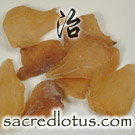 Bai Fu Zi6 gWarm Herbs that Transform Phlegm-Cold
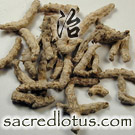 Jiang Can6 gExtinguish Wind and Stop Tremors
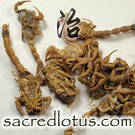 Quan Xie6 gExtinguish Wind and Stop Tremors
Preparation & dosage
How is Qian Zheng San prepared?
Classically, the three herbs are ground together in equal amounts into a fine powder and taken in roughly 3 g doses with warm wine (traditionally a warm rice/yellow wine) to help carry the formula’s wind-dispersing action to the face; some sources note warm water as an alternative vehicle when wine is not used. It may also be decocted as a tea, with the herb amounts reduced proportionally for a single-dose formula.
Source: Sacred Lotus sources & references + Bensky & Barolet, Formulas & Strategies (classical powder preparation taken with warm wine).
Powder: equal parts Bai Fu Zi, Jiang Can, Quan Xie (reference 6 g each), ground fine; approx. 3 g per dose taken with warm wine (or warm water), 2-3 times daily, for a short course. May be decocted instead, with amounts reduced proportionally. Reference only; a toxic-ingredient formula best used under a qualified practitioner.
Safety — read before use
What are the cautions for Qian Zheng San?
Two of the three ingredients are toxic, and the formula is contraindicated in pregnancy — it is meant for short-term use, in small doses, for the specific channel-level wind-phlegm pattern above, not as a general remedy for any facial weakness or stroke sequela.
- Bai Fu Zi is toxic in its fresh/unprocessed form and must be properly processed before internal use; the Sacred Lotus materia medica record for it advises against use during pregnancy.
- Quan Xie is slightly toxic (its venom contains neurotoxic peptides); it is dosed conservatively and is likewise contraindicated in pregnancy.
- Not for organ-level (zàng-fǔ) stroke — i.e., loss of consciousness, slurred speech, or limb hemiplegia — nor for facial deviation arising from Liver-yang rising or from blood/yin deficiency generating wind; those patterns need a different strategy.
- Because of the toxic ingredients, it is not intended for long-term or high-dose use and is generally reserved for short, practitioner-guided courses.
Source: Sacred Lotus sources & references for Bai Fu Zi and Quan Xie + Bensky & Barolet, Formulas & Strategies (pattern differentiation and contraindications). Traditional-use framing; not medical advice.
Originally Appeared In:
- Collected Formulas of the Yang Family (Yang Shi Jia Zang Fang)
Notes:
How does Qian Zheng San compare to other wind-stroke formulas, and how is it modified?
Qian Zheng San is deliberately narrow — three herbs aimed only at wind-phlegm in the facial channels — which sets it apart from broader wind-stroke formulas built for the whole body.
- vs Da Qin Jiao Tang: Da Qin Jiao Tang treats wind-stroke of the channels more broadly (face and limbs, with qi-and-blood-nourishing herbs added) for a more depleted constitution; Qian Zheng San is simpler and more sharply focused on the face alone.
- vs formulas for organ-level (zàng-fǔ) stroke (e.g., Su He Xiang Wan for the cold, closed pattern): those address loss of consciousness and require an entirely different strategy; Qian Zheng San never substitutes for them.
Common modifications: Bai Zhi, Fang Feng, and Chuan Xiong are often added to strengthen wind-dispersal and address facial pain or headache; Quan Xie is sometimes paired with Wu Gong (centipede) for a stronger wind-extinguishing effect in stubborn cases. Modern hospital protocols frequently pair a modified version (“jiawei Qian Zheng San”) with acupuncture or electroacupuncture rather than using the herbs alone.
One classical Chinese-language source records Quan Xie at half the amount of the other two herbs (3 g vs. 6 g each for Bai Fu Zi and Jiang Can) rather than equal parts. Sacred Lotus sources & references and the main English-language references (Bensky & Barolet; multiple herb-supplier formularies) use equal amounts of all three, which is the version presented here.
Source: Bensky & Barolet, Formulas & Strategies (comparisons, common modifications); cross-checked against Chinese-language materia medica references for the gram-amount variant.
Clinical Studies & Research:
Is there modern research on Qian Zheng San?
Yes, though the evidence base is still small — one recent animal study on the mechanism of nerve recovery and a retrospective clinical study combining it with electroacupuncture. In a 2025 mouse study of surgically crushed facial nerve, Qianzheng powder improved facial motor-function recovery and was linked to activation of the BDNF/TrkB/CREB signaling pathway, a pathway associated with nerve regeneration, with a favorable safety profile in the model. A separate retrospective study of 90 hospital patients with peripheral facial paralysis found that adding electroacupuncture plus Qianzhengsan decoction to standard care (prednisone and mecobalamin) improved the overall response rate and facial-nerve function versus standard care alone.
- Mechanism (preclinical, mouse): Qianzheng powder promoted facial nerve regeneration via BDNF/TrkB/CREB pathway activation after nerve-crush injury (PMID 41438125).
- Clinical (retrospective, n=90): electroacupuncture combined with Qianzhengsan decoction improved response rate and facial nerve function in peripheral facial paralysis versus medication alone (PMC 9478275).
Sources: PubMed 41438125; PMC 9478275. Research context, not a therapeutic claim; direct high-quality clinical trial evidence for the formula remains limited.
Sources & References
Compiled and edited by Thomas Dehli, Founder & Editor, Sacred Lotus Updated
The information here is referenced from numerous sources — teachers, practitioners, class notes from Five Branches University, the books below, and the published research literature, with citations given as resolvable PubMed identifiers. Where sources disagree, I have flagged the discrepancies directly. If facts couldn't be verified, I have left them out. How we source our content.
Reference information for students and practitioners — not medical advice. Consult a qualified practitioner. Terms of use.
Chinese Formulas Books & References
 https://amzn.to/4fYI3f8
 https://amzn.to/4j55NRA
 https://amzn.to/4gMROyv
 https://amzn.to/4h7msSK